INSTALLATION
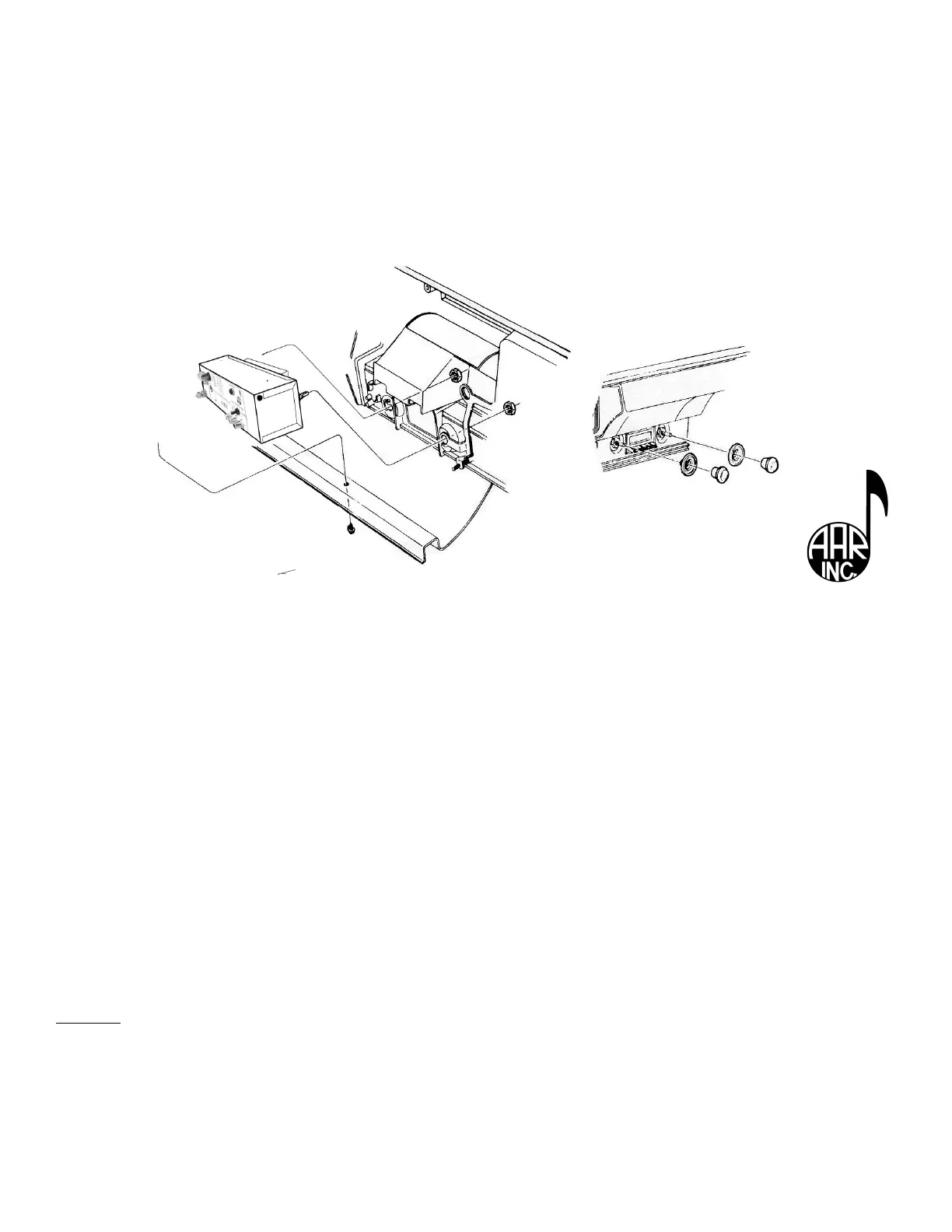
The drawing below shows the correct mounting method for all Olds F-85 dashes. Although the radio is much smaller and lighter than
the original, it will go into the dash the same way that the old one came out. To remove the original radio, remove the two 5/16” hex
screws from the lower A/C duct, pull down and out. Remove the knobs, backrings and shaft nuts. Unplug the antenna and
power/speaker plug. Remove the original rear radio mounting bracket and lower the radio out of the dash.
To install the new radio, remove the control knobs and backrings by pulling straight off. Remove the outer hex nuts from the control
shafts. Do Not remove or loosen the inner hex nuts that hold the control shafts in place. Set the radio into the dash and hold it in place
with the two hex shaft nuts. A 9/16” deep socket makes it easy to reach inside the knob well(s). Do not over-tighten. Finger tight plus
¼ turn is all you need. Replace the original rear mounting bracket with the 9” strap provided with your new radio (it should be bent to
shape). Slide the free hanging end of the radio mounting bracket over the stud on the rear passenger side of the radio housing and
secure with the 7/16” mounting nut provided. Plug the antenna into the jack on the lower rear of the radio near the mounting stud.
Install the backrings and knobs.
DIAGNOSTICS
No Sound: Check for a good fuse with proper rating. When the radio is turned on, the orange wire should have 12 volts present. Every
speaker lead should measure about 6 volts to ground with the radio on and volume low. During start up diagnostics if the radio detects
a shorted speaker wire the radio will shut off that speaker lead until the issue is resolved. Radio will mute when no station is received.
Make sure antenna is plugged into the proper jack. If an accessory is not connected there will be no audio in auxiliary mode.
Weak or No Reception: Check continuity between the center pin of the antenna plug and the antenna mast. It should read 0 ohms
(like a short) Next, check continuity between the center pin of the antenna plug and the car body. It should not read (like an open
circuit). If you’re in a metal building, reception may be limited. Try it outside.
Ignition Noise: Usually caused by an ungrounded antenna shield. The base of the antenna must make good contact with the car body.
This problem often shows up after a good paint job! Make sure the engine grounding straps are in place, clean and tightly bonded to
the frame.
Distortion: Check to see if your speakers can handle at least 45 watts RMS. Small speakers that can only reproduce high frequency
will distort on bass notes. Make sure speakers are properly installed. Make sure that no speaker is grounded. Every speaker lead
should measure about 6 volts to ground with the radio on and volume low. Resistance in the DC power input wiring can cause the
amplifiers to “starve”. If distortion seems to increase with volume, measure the voltage on the orange wire. If the voltage drops when
the volume is raised, it is an indication of resistance between the battery and the radio – usually at the fuse block, but sometimes in the
ignition switch. If the backstrap is not bolted to a clean metal ground, try running a heavy ground wire from the ground lug on the
radio directly to the firewall.
Radio shuts off after a few minutes: The radio has thermal protection built in to prevent damage from excessive heat. Possible
causes are shorted or grounded speaker wires. See if any unused wires can touch anything. Make sure the heater or defroster duct isn’t
blowing directly on the radio.
Dial pointer issues: If the dial pointer gets stuck at one end or if it is misaligned, hold down one of the preset buttons for 5-10
seconds to realign or free dial pointer. If the dial pointer is stuck at one end of the dial, turn the tuning knob. The dial pointer should
try to move while you're turning the knob. Continue to turn the tuning knob until the pointer resets itself.
BE SAFE: Make sure you are familiar with the way this radio works before you go out on the road. Driving demands your full
attention. Texting while driving is dangerous and it is illegal in many states. Remember: not all drivers have hands free phones, so the
guy next to you may be driving while distracted.
The Bluetooth® word mark and logos are registered trademarks owned by Bluetooth SIG, Inc. and any use of such marks by Antique Automobile Radio, Inc. is under license. Other trademarks and trade names are those of
their respective owners.
3 (end)


 To Previous Page
 Loading...