EasyManua.ls Logo

ABTECH SAFETY SLIX 100 - User Manual

ABTECH SAFETY SLIX 100
8 pages
Print Icon
To Next Page IconTo Next Page
Loading...
Instruction & Maintenance Manual for
SLIX 100 Stretcher
2021 V1.0
IMPORTANT
PLEASE READ THIS MANUAL BEFORE
USING THE SLIX100
This is not a manual of First Aid or Rescue techniques.
The SLIX stretcher may be used as a simple carry stretcher.
Rescuers using SLIX100 equipment involved in technical rescues from height or from confined spaces
using SLIX equipment should be trained in these disciplines.
It Is the responsibility of the rescue team to ensure that the casualty is secure at all times and that all
ropes, karabiners, slings or any other equipment attached to, or used to lift the Slix Stretcher is of suitable
strength and in good order.
All belays must be correctly installed and used by a competent person or persons.
Before using the Slix Stretcher check for wear or damage. Do not use if worn or damaged.
When lifting or lowering a Slix Stretcher in the vertical or horizontal mode a separate lifeline of suitable
strength should be used and standard-belayed separately.
The rescue team must be able to deal safely with any emergency that may arise during the evacuation of a
casualty.
Question and Answer IconNeed help?

Do you have a question about the ABTECH SAFETY SLIX 100 and is the answer not in the manual?

Summary

Slix100 Stretcher Overview

Identifying Slix100 Stretcher Components

Loading and Securing a Casualty

Fitting Vertical Haul Lines

Inspection and Cleaning Procedures

Stretcher Storage and Inspection Intervals

Product Certification

Declaration of Conformity

Formal statement of product compliance with CE and relevant directives.

Overview

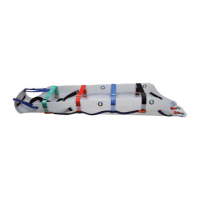
The ABTECH SLIX 100 Stretcher is a medical device designed for the safe and protective transport of casualties, particularly in adverse conditions or confined spaces. It is a Class I medical device, conforming to CE 93/42/EEC, and all supplied components are manufactured to relevant standards.

Function Description

The primary function of the SLIX 100 Stretcher is to facilitate the raising or lowering of a casualty, either vertically or horizontally. It is designed to secure a casualty during evacuation, accommodating various injuries and medical equipment such as leg splints and spinal splints. The stretcher can be used as a simple carry stretcher, but for technical rescues from height or confined spaces, rescuers must be trained in these specific disciplines.

Important Technical Specifications

  • Attachment Points: Colour-coded attachment eyelets for stretcher strops are rated at 400kg WLL (Working Load Limit).
  • Ropes and Lifelines: Haul ropes and lifelines must meet a minimum of EN1891 Type A standard. Recommended ropes are 11mm static fibre ropes or 5mm galvanised steel rope. Dynamic fibre ropes are discouraged due to potential "bouncing" which can cause discomfort to the casualty.
  • Components: The manual identifies numerous components with specific dimensions and quantities:
    • 100FCS (Foot Closure Straps): 2 straps, 25mm @ 140cm each.
    • 100FL (Foot Loops): 2 loops, 50mm @ 202cm each.
    • 100MCS (Main Closure Straps): 4 straps, 50mm @ 167cm each.
    • 100HCH (Head Carry Handles): 2 handles, 25mm @ 56cm each.
    • 100FCH (Foot Carry Handle): 1 handle, 25mm @ 78cm.
    • 100MCB (Main Closure Buckles): 4 buckles, 50mm @ 60cm each.
    • 100CH (Carry Handles): 2 handles, 25mm @ 250cm each.
    • 100SSA (Spinal Splint Attachments): 2 attachments, 25mm @ 32cm each.
    • SSVHSH (Velcro Head Strap Hook): 2 straps, Hook @ 28cm each.
    • SSTHS (Top Head Strap): 1 strap, 50mm @ 62cm.
    • SSVHSL (Velcro Head Strap Loop): 2 straps, Loop @ 28cm each.
    • SSBBS (Body Buckle Straps): 3 straps, 50mm @ 31cm each.
    • SSBS (Body Straps): 3 straps, 50mm @ 160cm each.
    • SSCS (Crutch Strap): 2 straps, 50mm @ 137cm each.
    • SSCBS (Crutch Buckle Strap): 2 straps, 50mm @ 31cm each.
    • Pads: SSHP (Head Pad), SSBP (Back Pad), SSLP (Lumbar Pad).
    • SLIXVHH (Vertical & Horizontal Stretcher Strops): These are the main lifting strops.

Usage Features

  • Storage and Deployment: The stretcher should be stored and transported in a dedicated Carry Bag. To use, it is removed from the bag, the securing strap is undone, and it is unrolled onto a flat surface near the casualty.
  • Casualty Positioning: The head of the stretcher should be level with the casualty's head.
  • Spinal Splint Integration: If a spinal splint is used, it is placed onto the SLIX Stretcher and attached to the Spinal Splint Plate using the provided 100SSA straps. The casualty is then positioned centrally on the spinal splint. Alternatively, if the casualty is loaded onto the spinal splint separately, they are carefully moved into the stretcher, and the spinal splint is attached.
  • Foot Loops: The 100FL Foot Loops are fitted to the casualty's feet (without removing footwear), crossing the straps over and adjusting buckles. If leg injuries are present, one or both foot loops may be omitted.
  • Closure Straps: The four 100MCS Main Closure Straps are secured across the stretcher, starting from the foot, and tightened securely. Care must be taken not to overtighten, especially at the chest, to avoid impairing respiration. Surplus strap length should be tucked away to prevent snagging.
  • Arm Positioning: It is recommended that the casualty's arms are kept inside the stretcher skin.
  • Foot Closure Straps: The 100FCS Foot Closure Straps are fed through a small eyelet and back through the buckle, adjusted until the rollover reveals the 100FCH Foot Carry Handle. Allowance should be made for leg splints.
  • Lifting Orientation:
    • Head Up Horizontal Lift: Achieved by attaching the Green Stretcher Strop to the Green Horizontal attachment points and the Blue Stretcher Strop to the Blue Horizontal attachment points.
    • Level Attitude: Achieved by reversing the Stretcher Strops (Blue to Green & Green to Blue).
  • Safety Precautions:
    • A separate lifeline of suitable strength must be used and belayed separately when lifting or lowering the stretcher in vertical or horizontal mode.
    • All equipment attached to or used with the stretcher (ropes, karabiners, slings) must be of suitable strength and in good order.
    • All belays must be correctly installed and used by competent personnel.
    • The rescue team must be capable of safely managing any emergency during evacuation.

Maintenance Features

  • Post-Use Inspection and Cleaning: After each use, the SLIX 100 Stretcher must be cleaned and inspected for damage by a competent person.
  • Cleaning Procedure:
    • Oil, grease, blood, body fluids, or non-aggressive contaminants can be removed with warm (not hot) water and soap.
    • A power washer can be used with care.
    • After cleaning, rinse thoroughly with clean water.
    • Hang vertically and allow to dry in a warm, dry atmosphere.
    • DO NOT APPLY HEAT.
  • Chemical Contamination: If any closure or stretcher strops have come into contact with chemicals, solvents, alkaline, acid, or any contaminant that could degrade polyethylene, polyester, or nylon, the stretcher and/or hauling strops MUST NOT BE USED under any circumstances.
  • Impact Inspection: If the stretcher has been subjected to a drop onto the vertical or horizontal hauling points during practice or an incident, it MUST BE INSPECTED by a competent person immediately and before further use.
  • Component Inspection:
    • Hauling Webbing Strops: Inspect for physical or chemical damage, paying particular attention to stitching and loop sections for wear. If damaged, DO NOT USE and replace immediately.
    • Closure Straps, Buckles, Handles, Foot Loops: Inspect all these components for physical or chemical damage. Damaged straps may be replaced by contacting the manufacturer. DO NOT USE THE STRETCHER before changing damaged straps.
    • Vertical Hauling Plate / Spinal Splint Attachment Point: Inspect for damage and/or distortion.
    • Stretcher Skin: Inspect the area around the Vertical Hauling Plate and Horizontal Attachment Points for distortion or splitting. If found, DO NOT USE.
  • Doubt about Integrity: If there is any doubt about the integrity of the SLIX100 Stretcher, contact the manufacturer.
  • Storage: The stretcher and spinal splint must be stored in the Carry Bag in a dry place, out of direct sunlight.
  • Sealing the Carry Bag: It is good practice to seal the bag with a tear-off, non-replaceable closure threaded through the top of the bag. This discourages tampering and ensures contents are present.
  • Regular Inspection: Abtech Safety Ltd recommends a detailed inspection every 6 months by a competent person, with the inspection logged.

ABTECH SAFETY SLIX 100 Specifications

General IconGeneral
BrandABTECH SAFETY
ModelSLIX 100
CategoryPersonal Care Products
LanguageEnglish