50-60 Hanover Road, Florham Park, New Jersey 07932
ASCO Valves
Page 2 of 2 Form No.V5433R3
CAUTION: Do not damage center hole (pilot orifice) in
piston assembly. Damage will cause valve malfunction.
4. Insert a wire, bent paper clip or similar tool into the bleed hole
on top of the piston assembly. Pull piston assembly, with piston
ring attached, from the valve body.
5. All parts are now accessible for cleaning or replacement. If parts
are worn or damaged, install a complete ASCO Rebuild Kit.
Valve Reassembly
1. Lubricate bonnet gasket with DOW CORNING 200 Fluid
lubricant or an equivalent high-grade silicone fluid.
2. Replace piston assembly, refer to Figure 1. A flexible plastic
sheet (Form No. V5661) is provided in the Rebuild Kit for
installation of the piston assembly. Wrap piston assembly with
plastic sheet; be sure one edge of the sheet is even with the top
of the piston assembly. Then compress piston ring with plastic
sheet and slide piston assembly into cavity.
CAUTION: Do not damage piston ring or force piston
assembly into valve body cavity. Damage to piston assembly
will cause valve malfunction.
When piston assembly is installed, remove and discard plastic sheet,
Form No. V5661.
3. Replace retainer with shouldered side up, bonnet gasket seats on
retainer shoulder. Install bonnet gasket, core with core spring
and solenoid base sub-assembly. Torque solenoid base
sub-assembly to 175 ± 25 in-lbs [19,8 ± 2,8 Nm].
4. Install solenoid, see separate instructions. Then make electrical
hookup to solenoid.
WARNING: To prevent the possibility of personal
injury or property damage, check valve for proper
operation before returning to service. Also perform
internal seat and external leakage tests with a
nonhazardous, noncombustible fluid.
5. Restore line pressure and electrical power supply to valve.
6. After maintenance is completed, operate the valve a few times
to be sure of proper operation. A metallic click signifies the
solenoid is operating.
ORDERING INFORMATION
FOR ASCO REBUILD KITS
Parts marked with an asterisk (*) in the exploded view are supplied in
Rebuild Kits. When Ordering Rebuild Kits for ASCO valves, order
the Rebuild Kit number stamped on the valve nameplate. If the
number of the kit is not visible, order by indicating the number of kits
required, and the Catalog Number and Serial Number of the valve(s)
for which they are intended.
Torque Chart
Part Name Torque Value Inch-Pounds Torque Value Newton-Meters
Solenoid Base Sub-Assembly 175 ± 25 19,8 ± 2,8
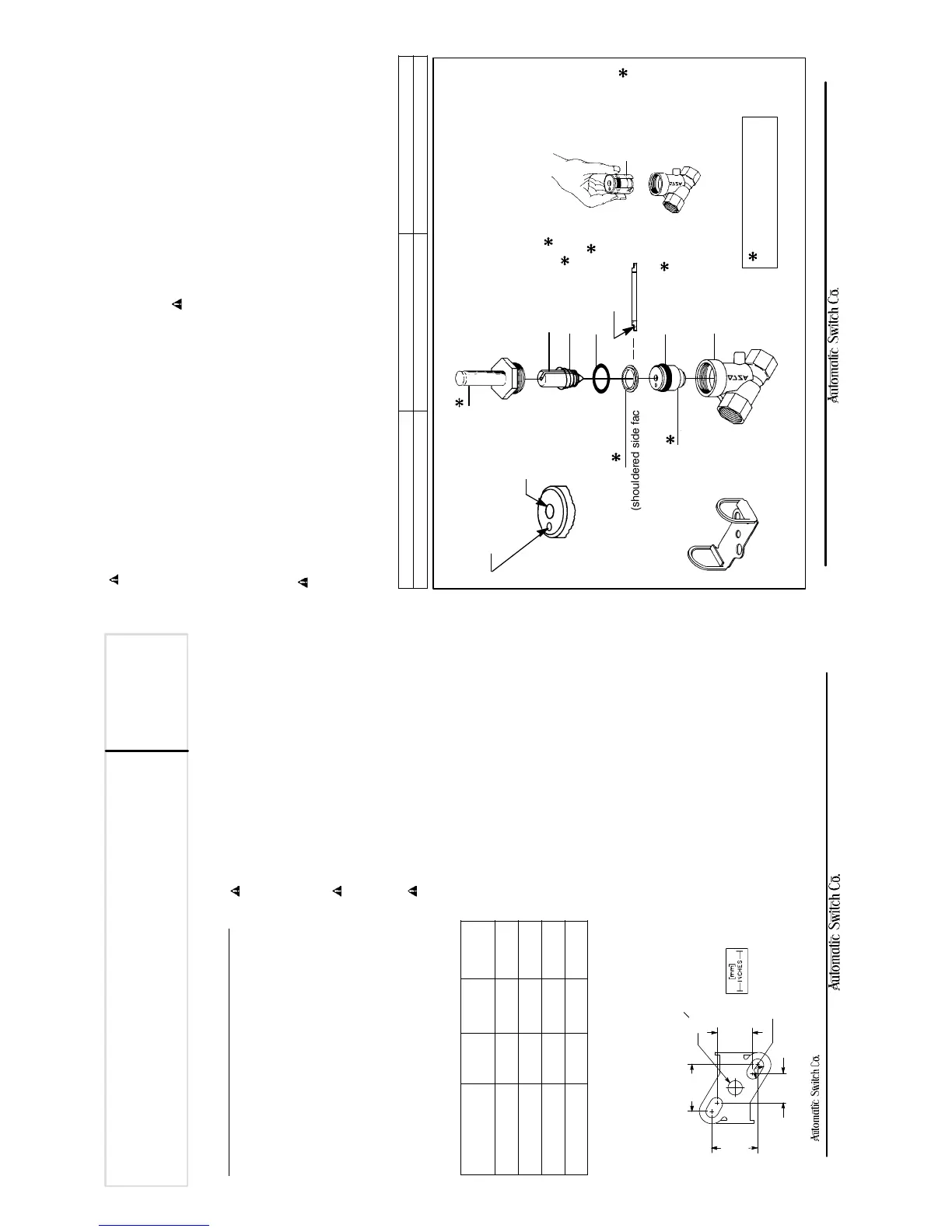
mounting bracket
(optional feature)
solenoid base
sub-assembly
core assembly
core spring
bonnet gasket
retainer
piston ring
piston
valve body
bleed hole
pilot orifice
(do not
flexible plastic
(Form No. V5661)
View showing replacement
IMPORTANT: A small flexible plastic sheet
(Form No. V5661) is provided in Rebuild Kit
for installation of piston assembly. Refer to
Valve Reassembly section, step 2.
of piston assembly
sheet
Partial view showing
top of piston assembly
assembly
damage)
Indicates Parts Supplied
In ASCO Rebuild Kits
(use for piston
removal)
Figure 2. Series 8222 valve without solenoid.
(shouldered side faces
bonnet gasket
bonnet gasket)
seats on shoulder
Page 1 of 2
50-60 Hanover Road, Florham Park, New Jersey 07932
ASCO Valves
MCMXCV All Rights Reserved.
Printed in U.S.A.
Installation & Maintenance Instructions
SERIES
Form No.V5433R3
2-WAY INTERNAL PILOT OPERATED SOLENOID VALVES
8222
1/4, 3/8, OR 1/2 NPT Ċ 3/8 ORIFICE
NORMALLY CLOSED OPERATION Ċ STEAM SERVICE
NOTICE: See separate solenoid installation and maintenance
instructions for information on: Wiring, Solenoid Temperature,
Cause of Improper Operation, Coil and Solenoid Replacement.
DESCRIPTION
Series 8222 valves are 2-way internal pilot-operated solenoid
valves designed for steam service. These valves are made of brass with
ethylene propylene elastomers.
OPERATION
Normally Closed: Valve is closed when solenoid is de-energized;
open when energized.
IMPORTANT: Minimum operating pressure differential is 1 psi.
INSTALLATION
Check nameplate for correct catalog number, pressure, voltage,
frequency, and service. Never apply incompatible fluids or exceed
pressure rating of the valve. Installation and valve maintenance to be
performed by qualified personnel.
Future Service Considerations
Provision should be made for performing seat leakage, external
leakage, and operational tests on the valve with a nonhazardous,
noncombustible fluid after disassembly and reassembly.
Temperature Limitations
For maximum valve ambient and fluid temperatures, see chart below.
Catalog Numbers
Class of
Insulation
Maximum
Ambient
Temp.F
Maximum
Fluid
Temp. F
8222A64, 8222A66
8222A68
F 85 324
8222A70, 8222A74
8222A76
H 85 353
8222G64, 8222G66
8222G68
F 125 324
8222G70, 8222G74
8222G76
H 140 353
Positioning
This valve is designed to perform properly when mounted in any
position. However, for optimum life and performance, the solenoid
should be mounted vertically and upright to reduce the possibility of
foreign matter accumulating in the solenoid base sub-assembly area.
Mounting
For mounting bracket (optional feature) see Figure 1.
.88
.59
.266 Dia.
.86 .69
.125 R.
(2 holes)
[18]
[15]
[22]
[22]
[3,2]
[ 6,8]O
Figure 1. Mounting dimension of optional mounting bracket.
Piping
Connect piping or tubing to valve according to markings on valve
body.
CAUTION: This valve is equipped with ethylene
propylene elastomers which can be attacked by oils and
greases. Wipe the pipe threads clean of cutting oils.
Apply pipe compound sparingly to male pipe threads only. If applied
to valve threads, the compound may enter the valve and cause
operational difficultly. Avoid pipe strain by properly supporting and
aligning piping. When tightening the pipe, do not use valve or
solenoid as a lever. Locate wrenches applied to valve body or piping
as close as possible to connection point.
CAUTION: To protect the solenoid valve, install a strainer
or filter, suitable for the service involved, in the inlet side as
close to the valve as possible. Clean periodically depending
on service conditions. See ASCO Series 8600, 8601, and 8602
for strainers.
MAINTENANCE
WARNING: To prevent the possibility of personal
injury or property damage, turn off electrical power,
depressurize valve, and vent fluid to a safe area before
servicing the valve.
NOTE: It is not necessary to remove the valve from the pipeline for
repairs.
Cleaning
All solenoid valves should be cleaned periodically. The time between
cleanings will vary depending on the medium and service conditions.
In general, if the voltage to the coil is correct, sluggish valve operation,
excessive noise, or leakage will indicate that cleaning is required. In
the extreme case, faulty valve operation will occur and the valve may
fail to open or close. Clean strainer or filter when cleaning the valve.
Preventive Maintenance
Keep medium flowing through the valve as free from dirt and
foreign material as possible.
While in service, the valve should be operated at least once a
month to ensure proper opening and closing.
Depending on the medium and service conditions, periodic
inspection of internal valve parts for damage or excessive wear is
recommended. Thoroughly clean all parts. If parts are worn or
damaged, install a complete ASCO Rebuild Kit.
Causes of Improper Operation
Incorrect Pressure: Check valve pressure. Pressure to valve must
be within range specified on nameplate.
Excessive Leakage: Disassemble valve and clean all parts. If parts
worn or damaged, install a complete ASCO Rebuilt Kit.
Valve Disassembly
1. Disassemble valve in an orderly fashion. Use exploded views for
identification and placement of parts.
2. Remove solenoid, see separate instructions.
3. Unscrew solenoid base sub-assembly from valve body. Then
remove core with core spring, bonnet gasket and retainer from
valve body.


 To Next Page
 Loading...