- 17 -
10A\ Scelta e manutenzione delle lame
La tabella “MISURE LAME “ definisce la misura minima e massima di lunghezza , la larghezza max e lo spessore consigliato delle
lame secondo il tipo di macchina. La scelta della larghezza e del tipo di dente è in funzione del materiale da tagliare e del tipo di
lavorazione : le lame strette sono indicate per tagli curvlinei, sagome ecc.., le lame largehe per tagli rettilinei. Si consiglia dentatura
fine per legni duri e grossa per legni teneri, lospazio tra i denti deve essere comunque tale da assicurare lo scarico della segatura
prodotta durante il taglio, se lo scarico non è regolare può causare il surriscaldamento e l’inceppamento del nastro con conseguente
rottura. Non usare lame deformate o incrinate .La stradatura della lama sarà più grande ( 2 volte lo spessore ) per legni teneri e
fibrosi, 1,5 volte lo spessore per legni duri.
Si raccomanda di cambiare tempestivamente la lama quando l’affilatura diventa insufficiente e di rivolgersi a laboratori specializzati
per le operazioni di saldatura , affilatura e stradatura ; si raccomanda l’impiego di lame di buona qualità.
Causa di rottura delle lame :
- Spessore troppo grande rispetto al diametro dei volani
- Saldatura difettosa
- Tensionamento inadeguato, in particolare se la lama è troppo tesa la molla di tensione non esercita più la sua funzione.
- Affaticamento del materiale dovuto a taglio con lama non ben affilata e stradata o al mancato detensionamento della lama Dopo
l’utilizzo si raccomanda il detensionamento specialmente nella pausa notturna (con l’impiego di cartello segnalatore)
- Disassamento dei volani dovuto a interventi non autorizzati sulle viti di regolazione del volano inferiore .
- Irregolarità della copertura dei volani, ad esempio per accumulo di incrostazioni durante il taglio di essenze resinose.
GB 10A\ Choice and maintenance of the blades
The “ BLADE DIMENSIONS “ table defines the minimum and max. blade length,maximum width and the recommended blade
thickness , depending on the type pf the machine.
Selection of width and type of tooth depends upon the materials to be cut and the type of operation : narrow blades are suitables for
cutting curved lines ,profiles etc.., wide blades are suitable for straight cutting.
It is advisable to use fine teeth for hard woods and coarse teeth for softwoods.In every case, the distance between each tooth should
be sufficient to clear the sawdust produced during the cutting operation. If the clearance is not correct this can cause overheating and
jamming of the blade , causing subsequent breakage .
Do not use flawed or deformed blades.
The setting value of the blade is max. two times blade thickness for soft woods,1.5 times the blade thickness for hard wood.
It is higly recommended that the blade be changed regularly once the sharpness becomes insufficient, and to use a specialised
workshop for welding, sharpening and re-setting ofblades.The use of high quality blades is also recommended
Causes of blade breakage:
- Excessive blade thickness in relation to the fly-wheel diameter
- Defective welding
- Incorrect tension,particularly if the blade is too tense the tension spring no longer fulfils its function
- Overloading the blade caused by used a badly ground or badly set blade,or by not slacking the tension
. After use it is recommended to slacken the tension,especially overnight,(placing a visible notice of this operation)
- Misalignment of the fly-wheels due to unauthorized intervention of the regulating screws of the lower fly-wheel
- Irregularity of fly-wheels surface , e.g. an accumulation of sawdust whilst cutting resinous materials.
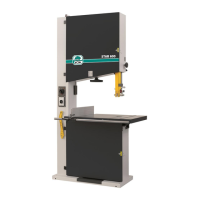
MISURE LAME- MESURES DES LAMES - BLADE MEASUREMENTS
MOD
Type
Star 400
Star 440
Star 500
Star 600
Star 700
Star 800
L MIN mm 3560 3650 4050 4520 4990 5630
L MAX mm 3640 3730 4130 4600 5040 5700
MAX WIDTH
30 30 35 35 40 45
Spessore-
Thicknessser
Bandstarke
0,4 0,4 0,5 0,6 0,7 0,8
MOD
Type
BS 540 BS 640 BS 740 BS840 BS940
L MIN mm 4190 4730 5340 6000 6590
L MAX mm 4260 4800 5420 6110 6710
MAX WIDTH
35 35 40 45 50
Spessore-
Thicknesser
Bandstarke
0,5 0,6 0,7 0,8 0,9


 To Next Page
 Loading...