Universal Timpani Manual www.adams-music.com
8
9
4
Adjust the letters: set all similar tones (identical and octaves) before moving to
another tone. Begin with A2.
3
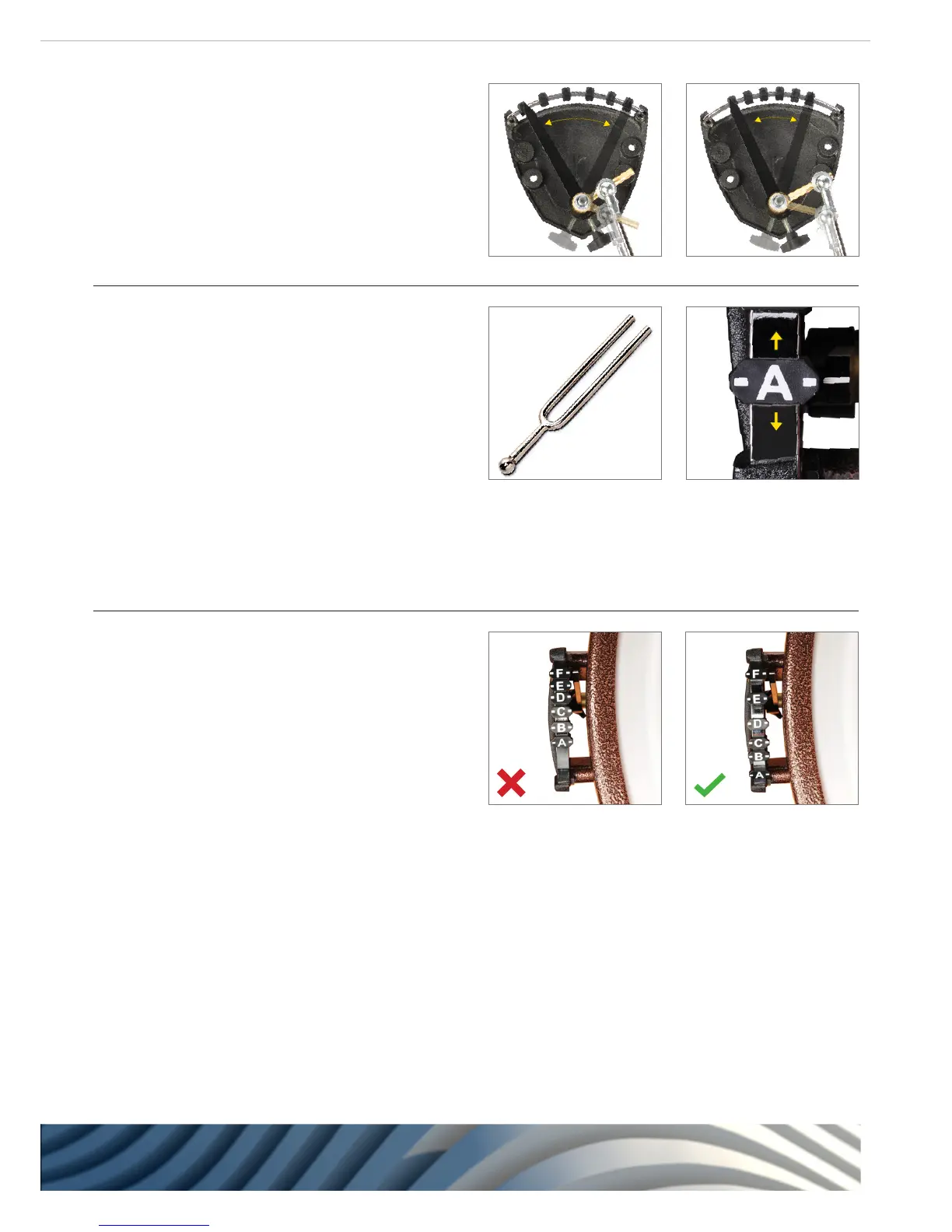
Set the range of motion.
Use a tuning fork or other tuning
device as a tone source.
4.1
4.2
4.3
4.4
4.5
•
•
•
•
For more distance, move the fitting towards the axel.
For less distance, move the fitting toward the tip.
Move the pedal to the position of the lowest tone.
Move the pedal through the scalar to view the distance that the pointer
moves. Determine if more or less distance is necessary in the range in
the motion.
Tune A2 on the 29” timpani.
Set the 29" A indice.
Tune A2 on the 26” timpani and match it to the 29”.
Set the 26” A indice.
Tune A3 on the 23” timpani, one octave higher than A2. Begin with the
tone source, and tune with the octave A2 on the 29”.
Set the 23” A indice.
Tune A3 on the 20” timpani, and match it to the 23”.
Set the 20” A indice.
Repeat steps 4.1-4.5 with B, C, D, E, F, G: match identical tones and
octaves.
5
Maintenance
A head will stretch over time, lowering the fundamental tone. The tuning gauge
will become inaccurate when this happens. Restore correct tuning gauge
function by correcting the fundamental tone of the head as described on page 5.
If moving the letters is required after correcting the fundamental tone, the
letters will usually end up with very little space between the letters as
demonstrated in the incorrect picture. When this happens, the head has
stretched to the point that is needs to be replaced.


 To Next Page