The ADDAC200PI Pedal Integrator is a Eurorack module designed to seamlessly integrate external guitar pedals and other line-level effects into a modular synthesis setup. This module acts as a bridge, allowing users to send audio signals from their Eurorack system to external effects pedals and then return the processed audio back into the modular environment. This integration capability significantly expands the sonic possibilities of a Eurorack system by leveraging the vast array of available stompboxes and outboard gear.
Function Description:
The ADDAC200PI features four independent send and return loops, labeled "SEND 1," "RECEIVE 1," "SEND 2," and "RECEIVE 2." Each loop is designed to handle a single external effect pedal. The "SEND" jacks output a signal from the Eurorack system, typically at modular levels, which is then attenuated to a pedal-friendly level before being sent to the input of an external pedal. The "RECEIVE" jacks accept the processed signal from the output of the external pedal and then boost it back to modular levels, making it compatible with other modules in the Eurorack system.
In addition to the send/receive loops, the module also includes four independent input and output jacks, labeled "INPUT 1," "OUTPUT 1," "INPUT 2," and "OUTPUT 2." These jacks provide further routing flexibility, allowing for direct input of external audio into the module or direct output of signals from the module to other destinations. While the primary function revolves around integrating pedals, these additional I/O points can be used for various purposes, such as routing audio through the module's internal circuitry (if any, though this module primarily focuses on signal conditioning for external effects) or simply as convenient buffered I/O for other Eurorack signals.
The module is designed to operate within the standard Eurorack power specifications, typically +/-12V. The internal circuitry includes components for signal conditioning, level matching, and buffering to ensure optimal performance and compatibility between the modular and pedal worlds. This includes attenuating modular signals to instrument level for pedals and boosting instrument-level signals back to modular level upon return. The design aims to maintain signal integrity and minimize noise during these conversions.
Important Technical Specifications:
While specific detailed technical specifications like exact impedance matching values, signal-to-noise ratio, or frequency response are not explicitly provided in the given manual excerpts, the module's core function implies certain characteristics:
- Power Consumption: As a Eurorack module, it will draw power from the Eurorack bus. The "POWER_RAILS" section on the PCB indicates connections for -12V, +12V, and GND, which are standard for Eurorack modules. The presence of a "RED STRIPE" indicator on the power header is crucial for correct orientation when connecting to the Eurorack power supply.
- Signal Level Conversion: The module performs bidirectional signal level conversion:
- Modular Level to Instrument Level (for "SEND" jacks): This typically involves attenuating a Eurorack signal (e.g., +/-5V or +/-8V) down to instrument level (e.g., around -10dBV or +4dBu, depending on the pedal's expected input).
- Instrument Level to Modular Level (for "RECEIVE" jacks): This involves boosting the instrument-level signal from a pedal back up to Eurorack modular levels.
- Input/Output Types: All jacks appear to be 3.5mm (1/8") mono TS (Tip-Sleeve) jacks, which are standard for Eurorack modules. This means they handle unbalanced audio signals.
- Module Width: Based on the visual representation, the module appears to be a relatively narrow Eurorack module, likely in the range of 6HP to 10HP, designed to fit efficiently into a modular case.
- Componentry: The PCB images show various electronic components, including capacitors (e.g., 47pf, 10uf, 100uf), resistors, and integrated circuits (though specific ICs are not clearly identifiable). These components are essential for buffering, filtering, and level shifting. The presence of multiple capacitors suggests careful attention to power supply filtering and signal coupling.
Usage Features:
- Seamless Pedal Integration: The primary feature is the ability to easily incorporate external effects pedals into a Eurorack patch. This allows users to leverage their existing collection of guitar pedals, which often offer unique sounds and effects not commonly found in Eurorack modules.
- Four Independent Loops: With four distinct send/receive loops, users can integrate up to four different pedals simultaneously or create complex signal chains by routing signals through multiple pedals in series or parallel.
- Flexible I/O: The additional "INPUT" and "OUTPUT" jacks provide extra routing options, making the module versatile beyond just pedal integration. For example, a user could send a signal from "OUTPUT 1" to an external mixer or audio interface, or bring an external audio source into the Eurorack system via "INPUT 1."
- Modular System Expansion: By integrating pedals, the ADDAC200PI significantly expands the sonic palette of a Eurorack system without requiring the purchase of dedicated Eurorack versions of common effects. This can be a cost-effective way to add effects like overdrive, distortion, reverb, delay, chorus, or modulation from the world of guitar pedals.
- Creative Sound Design: The ability to mix and match modular signals with pedal effects opens up new avenues for creative sound design, allowing for unique textures and processing techniques that combine the strengths of both domains.
Maintenance Features:
The provided manual excerpts primarily focus on the assembly process, indicating that this module is available as a DIY (Do It Yourself) kit. This implies certain maintenance considerations:
- DIY Assembly: Users are responsible for soldering all components onto the PCB and assembling the module. This requires basic soldering skills and familiarity with electronic components. The assembly guide provides step-by-step instructions for placing and soldering components like capacitors, pin headers, and jacks.
- Component Replacement: As a DIY module, individual components (resistors, capacitors, jacks, etc.) can theoretically be replaced if they fail. This makes the module repairable for those with soldering skills.
- Troubleshooting: The assembly guide implicitly serves as a troubleshooting aid during the build process, ensuring correct component placement and orientation. For post-assembly issues, basic electronic troubleshooting skills would be beneficial.
- Robust Construction: Once assembled, the module is designed to be housed within a Eurorack case, providing physical protection for the internal circuitry. The use of nuts to secure the jacks and PCBs to the front panel ensures a sturdy construction.
- Cleaning: Like any electronic device, periodic cleaning of the front panel and jacks to remove dust and grime would be beneficial for long-term reliability.
In summary, the ADDAC200PI Pedal Integrator is a crucial utility module for Eurorack users looking to bridge the gap between their modular system and external effects pedals. Its design focuses on signal conditioning and flexible routing, making it an invaluable tool for expanding sound design possibilities and leveraging a wider range of audio processing tools.

 Need help?
 General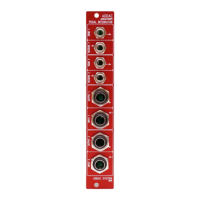

 To Next Page