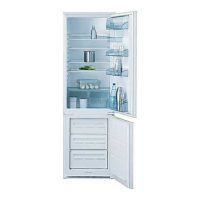
This document provides operating and installation instructions for the AEG SANTO N 7 18 40-4i Integrated Fridge Freezer.
Function Description
The appliance is an integrated fridge freezer designed for household use, suitable for cooling, freezing, and storing frozen food, as well as for making ice. It features separate compartments for refrigeration and freezing, with independent temperature regulation for the freezer compartment. The refrigerator compartment includes a dairy compartment, hanging storage box, can storage shelves, bottle storage shelf, light lamp, glass shelves, and salad drawers. The freezer compartment includes specific compartments for freezing fresh food and storing frozen food, along with ice packs for extended cooling during power failures.
Important Technical Specifications
- Refrigerant: Isobutane (R600a), a natural gas with high environmental compatibility.
- Light Bulb Data: 220-240 V, max. 15 W.
- Housing Dimensions:
- Height: 1780 mm
- Depth: 550 mm
- Width: 560 mm
- Electrical Connection: The appliance is supplied with a 13 amp plug fitted. A 13 amp ASTA approved (BS 1362) fuse must be used if changing the fuse. The mains lead wires are coloured: Green and Yellow for Earth, Blue for Neutral, and Brown for Live.
- Climate Classification:
- SN: +10 to +32 °C ambient temperature
- N: +16 to +32 °C ambient temperature
- Freezing Capacity: The maximum quantity of fresh food that can be frozen within a 24-hour period is specified on the rating plate. For freezing food over several days, the maximum capacity should be limited to 2/3 to 3/4 of the rating plate capacity.
- EU Guidelines Compliance:
- 73/23/EWG dated 19 February 1973 - low voltage guidelines.
- 89/336/EWG dated 3 May 1989 (including guideline change notice 92/31/EWG) - EMV guideline.
Usage Features
- Starting Up and Temperature Regulation (Refrigerator):
- The temperature control knob is located on the right-hand side of the refrigerator compartment.
- Setting "0" turns the appliance off.
- Setting "1" is the highest temperature (warmest setting).
- Setting "6" (end-stop) is the lowest temperature (coldest setting).
- Temperature depends on the quantity of food stored and how often the door is opened.
- For rapid freezing, select setting "6" initially, then return to "3" or "4" once food is frozen.
- High ambient temperatures and cold settings can cause continuous compressor operation; adjust to a warmer setting ("3" or "4") if this occurs.
- Control Panel of Freezer Compartment:
- A. Pilot light (green): Comes on when mains voltage is available.
- B. Thermostat knob: Also serves as the on/off switch for the freezer compartment.
- C. Super control light (yellow): Comes on when the Normal/Super push button is pressed.
- D. Normal/Super push button: Activates Quick-freezing.
- Starting Up and Temperature Regulation (Freezer):
- Turn the thermostat regulator (B) to "1" to start the freezer motor and illuminate the green pilot light (A).
- Setting "0" turns the freezer off.
- Setting "1" is the highest temperature (warmest setting).
- Setting "4" (end-stop) is the lowest temperature (coldest setting).
- Temperature depends on food quantity, door opening frequency, and ambient temperature.
- Quick-freezing:
- Press the Normal/Super button (D) to activate, illuminating the yellow super control light (C).
- Accelerates freezing of fresh food and protects stored food from warming.
- Automatically switches off after 52 hours if not manually ended.
- Can be manually ended by pressing the Normal/Super button again.
- Interior Accessories:
- Storage Shelves: Adjustable to various heights. The glass shelf above the fruit and vegetable compartment should remain in position.
- Variable Inner Door: Door compartments can be pulled up, removed, and reinserted at other positions.
- Variable Storage Box: Some models have a storage box under a door shelf compartment that can be slid sideways and inserted under any door shelf compartment.
- Fresh Food Refrigeration:
- Do not store warm food or evaporating liquids.
- Cover or wrap food, especially those with strong flavours.
- Position food for free air circulation.
- Meat: Wrap in polythene bags, place on the glass shelf above vegetable drawers, store for 1-2 days.
- Cooked foods/cold dishes: Cover and place on any shelf.
- Fruit and vegetables: Clean thoroughly, place in special drawers.
- Butter and cheese: Place in airtight containers or wrap in foil/polythene bags.
- Milk bottles: Cap and store in the bottle rack.
- Bananas, potatoes, onions, garlic: Do not keep in the refrigerator unless in airtight containers.
- Freezing and Storing Frozen Food:
- Freezer temperature must be -18 °C or colder before freezing.
- Allow warm food to cool before freezing to prevent increased ice formation and power consumption.
- Do not refreeze thawed foods that have not been processed.
- Do not store flammable gases/liquids (e.g., spray cans, fire extinguisher refills) or bottles/cans (e.g., lemonade, juices, beer, wine, sparkling wine) in the freezer due to explosion risk.
- Pack all foods airtight to prevent drying out, flavour loss, and contamination.
- Avoid touching frozen food with wet hands.
- Keep drawers in place for correct air circulation.
- Place packed food in drawers; food to be frozen goes in the upper basket, not touching already frozen items.
- For fresh food freezing, press the ambient temperature switch (A) 24 hours prior to loading, then depress it again after freezing.
- Sort frozen foods by type in drawers.
- Ice Pack: Two ice packs are in one freezer drawer. Place in the uppermost drawer, at the front, above frozen food, to extend cooling time during power failures. Can also be used for cooling cold bags.
- Preparation of Ice Cubes: Fill trays 3/4 full with cold water, place in freezer. Twist tray or run under water to loosen cubes. Use the provided ice scraper for frozen trays.
- Storage Goods Symbols/Freezing Calendar: Symbols on drawers indicate food types; numbers indicate storage times in months (upper value for good quality/pre-treated, lower for high fat content).
- Switching Off: Turn temperature regulator to "0" or disconnect from electricity supply. For extended periods, remove plug, remove all contents, defrost and clean, then leave door open.
Maintenance Features
- Defrosting (Refrigerator): Automatic defrosting occurs when the motor compressor stops. Defrost water drains into a trough at the back of the appliance and evaporates over the motor compressor. Periodically clean the defrost-water drainage outlet with the provided cleaner to prevent overflow.
- Defrosting (Freezer): Inner walls of the freezer are automatically defrosted.
- Cleaning and Care:
- Regularly clean the interior and accessories for hygiene.
- Always disconnect from electricity supply before cleaning.
- Do not use steam cleaners; moisture can damage electrical components.
- Ensure the appliance is dry before switching back on.
- Avoid ethereal oils, organic solvents (lemon juice, orange peel juice, butyric acid), and cleansers containing acetic acid, as they can attack plastic parts.
- Clean the outer casing with warm water and a little washing-up liquid.
- Remove all food before cleaning. Wrap frozen food in newspaper and store in a cool, covered place.
- Clean interior with lukewarm water and a little bicarbonate of soda (5ml to 0.5 litre of water).
- Dry thoroughly.
- Check and clear the water drain hole on the fridge's rear wall using the provided tool.
- Switch the appliance back on once dry.
- Changing the Light Bulb:
- Warning: Risk of electric shock. Switch off appliance and unplug or pull fuse/circuit breaker.
- Turn temperature regulator to "0".
- Unplug mains plug.
- Undo the screw, press and slide back the light bulb cover.
- Change the defective bulb (220-240 V, max. 15 W).
- Refit cover and screw.
- Switch appliance back on.

 Need help?

 To Next Page
 General