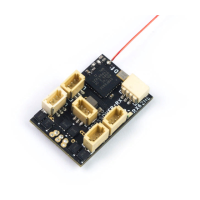
This document provides an instruction manual for the AEORC RX14x, RX14x-E, RX15x-E, RX24x, RX34x, and RX44x series of mini micro receivers. These receivers are designed for various remote control applications, primarily in fixed-wing aircraft, and integrate different types of electronic speed controllers (ESCs) and servo control functions.
Function Description:
The AEORC mini micro receivers serve as the central control unit for remote-controlled aircraft. They receive signals from a transmitter, interpret them, and control the connected components such as motors and servos. The receivers support multiple communication protocols, including S-FHSS, DSMX/2, FRSKY-D16, FRSKY-D8, and Flysky (AFHDA-2A), ensuring compatibility with a wide range of transmitters.
Many models integrate an Electronic Speed Controller (ESC) directly onto the receiver board, simplifying wiring and reducing overall weight. These integrated ESCs can be either brushed or brushless, with varying current ratings and cell compatibility (e.g., 5A/1S, 7A/2S, 15A/2-3S). Some models also feature built-in servo drivers, such as 2CH linear servo drivers or 2CH electromagnetic servo drivers, further consolidating components.
A key feature across several series is the TELEM function (telemetry), which allows real-time monitoring of critical flight parameters. This includes battery voltage, receiver voltage, receiver signal strength, and receiver operating temperature. This data is transmitted back to a compatible transmitter, enabling users to monitor the working status of the receiver and battery during flight and prevent unexpected situations.
Certain receivers, like the RX14x-E and RX15x-E series, offer an "Aileron double servo mode." This function simplifies the connection and setup for aircraft requiring two aileron servos (left and right), by setting CH3 to CH4 inverted output when a specific pad ("P") is short-circuited.
Important Technical Specifications:
RX14x Series:
- Size: 12.018.66.5mm
- Weight: 0.9g (without wire)
- Working Voltage: 3.0-5.0V
- Integrated ESC: 5A/1S Brushed ESC
- Features: Automatic frequency matching, TELEM (specific versions)
RX14x-E Series:
- Size: 12.022.56.5mm
- Weight: 1.3g (without wire)
- Working Voltage: 3.3-4.2V
- Integrated ESC: 5A/1S Brushless ESC
- Features: 5V boost circuit, Aileron double servo mode, Automatic frequency matching, TELEM (specific versions)
RX15x-E Series:
- Size: 16.024.06.8mm
- Weight: 2.0g (without wire)
- Working Voltage: 6.0-12.6V
- Integrated ESC: 7A/2S Brushless ESC
- Features: 3.9V buck circuit, Aileron double servo mode, Automatic frequency matching, TELEM (specific versions)
RX24x Series:
- Size: 25238mm
- Weight: 4g
- Working Voltage: 3.5-5.0V
- Servo Plug: 1.00Pin 3P JST
- Power Plug: 1.25Pin 2P JST(51005)
- Integrated ESC: 5A/1S Brushed ESC
- Features: 2CH Linear Servo, TELEM (specific versions)
RX34x Series:
- Size: 16102.5mm
- Weight: 0.5g
- Working Voltage: 3.0-4.2V
- Integrated ESC: 5A/1S Brushed ESC
- Features: Built-in 2CH electromagnetic servo driver (512 class resolution), 5CH PWM signal output, TELEM (specific versions)
RX44x Series:
- Size: 28.0189.8mm (without wire)
- Weight: 5.2g (without wire), 7.1g (with wire)
- Working Voltage: 7.4-12.6V
- Built-in ESC: 15A 2-3S ESC (BEC: 5V/2A)
- Features: Over voltage protection, 6CH PWM signal output (standard servo plug), TELEM (specific versions)
Usage Features:
- Binding Process: The general procedure for combining the receiver and transmitter involves powering on the transmitter, then the receiver. The receiver's LED will flash slowly while confirming the transmitter signal. If no signal is confirmed within 15 seconds, the receiver enters an automatic frequency matching mode, indicated by a fast-flashing LED. Successful binding is confirmed by various LED light feedback patterns depending on the remote transmitter type. For the RX44x series, binding involves pressing and holding a dedicated binding button for about 2 seconds until the red LED flashes from slow to quick, then releasing the button and setting up the transmitter to bind.
- ESC Operation (Brushed): For receivers with brushed ESCs (e.g., RX14x, RX24x, RX34x), the positive pole of the motor connects to "M+" and the negative pole to "M-". These ESCs typically have a lock function to prevent accidental activation. After powering on, the throttle channel must remain at the lowest position for more than 2 seconds to cancel this lock and enable normal ESC operation.
- ESC Operation (Brushless): For receivers with brushless ESCs (e.g., RX14x-E, RX15x-E, RX44x), the three wires of the brushless motor connect to the "THR" pins. Users must pay attention to the motor's rotation direction; if it needs to be changed, any two of the three motor wires should be swapped. Brushless ESCs in the RX14x-E and RX15x-E series support the DSHOT protocol, which eliminates the need for throttle stroke calibration and offers faster signal transmission and higher refresh rates compared to traditional brushless ESCs. For RX44x, the three motor wires are soldered to specific "Brushless Motor" dots, and the motor rotation direction should be confirmed before soldering.
- Servo Control:
- Linear Servos (RX24x): After binding, two linear servos can be controlled, typically used for horizontal and vertical tails. Channel sequence or reversal can be adjusted via the transmitter's channel mapping function.
- Electromagnetic Servos (RX34x): The positive pole connects to "CH1 Magnet Servo 1" and the negative pole to "CH2 Magnet Servo 2". Servo positive inversion needs to be set up with the transmitter.
- PWM Signal Servos (RX34x, RX44x): Standard PWM servos connect with their negative, positive, and signal wires to GND, VIN, and respective CH1-CH6 pins. Users must confirm the voltage range of their servos.
- Aileron Double Servo Mode (RX14x-E, RX15x-E): This mode is enabled by short-circuiting the "P" pad on the receiver board. It simplifies the setup for aircraft with two aileron servos by configuring CH3 as an inverted output of CH4. To disable this function, the "P" pad should be disconnected.
- Telemetry (TELEM) Function: Requires a compatible remote control with TELEM functionality. It provides real-time monitoring of battery voltage, receiver voltage, signal strength, and operating temperature, allowing pilots to maintain awareness of their aircraft's status.
Maintenance Features:
- Automatic Frequency Matching: The receivers are designed to automatically enter frequency matching mode if a transmitter signal is not confirmed within 15 seconds of power-on. This simplifies the re-binding process if a connection is lost or a new transmitter is used.
- ESC Lock Function (Brushed): The integrated brushed ESCs include a safety lock to prevent accidental motor startup. This requires the throttle channel to remain at its lowest position for at least 2 seconds after power-on to disarm the ESC, which is a built-in safety measure.
- DSHOT Protocol Support (Brushless): For brushless ESCs supporting DSHOT, no throttle stroke calibration is needed, which simplifies setup and reduces potential calibration errors. The faster signal transmission and higher refresh rate also contribute to more responsive and potentially more stable control.
- Over Voltage Protection (RX44x): The RX44x series includes over-voltage protection, enhancing the durability and safety of the receiver and connected components.
- Modular Design: The various series and versions cater to different needs, allowing users to select the most appropriate receiver with integrated features (ESC type, servo drivers, telemetry) for their specific aircraft and application, which can simplify maintenance by reducing the number of separate components.
- Clear Interface Definitions: Detailed diagrams for each receiver series clearly label all connection points for motors, servos, and power, aiding in correct wiring and troubleshooting.


 To Next Page
 Need help?

 General