PROGRAM INFORMATION
P7
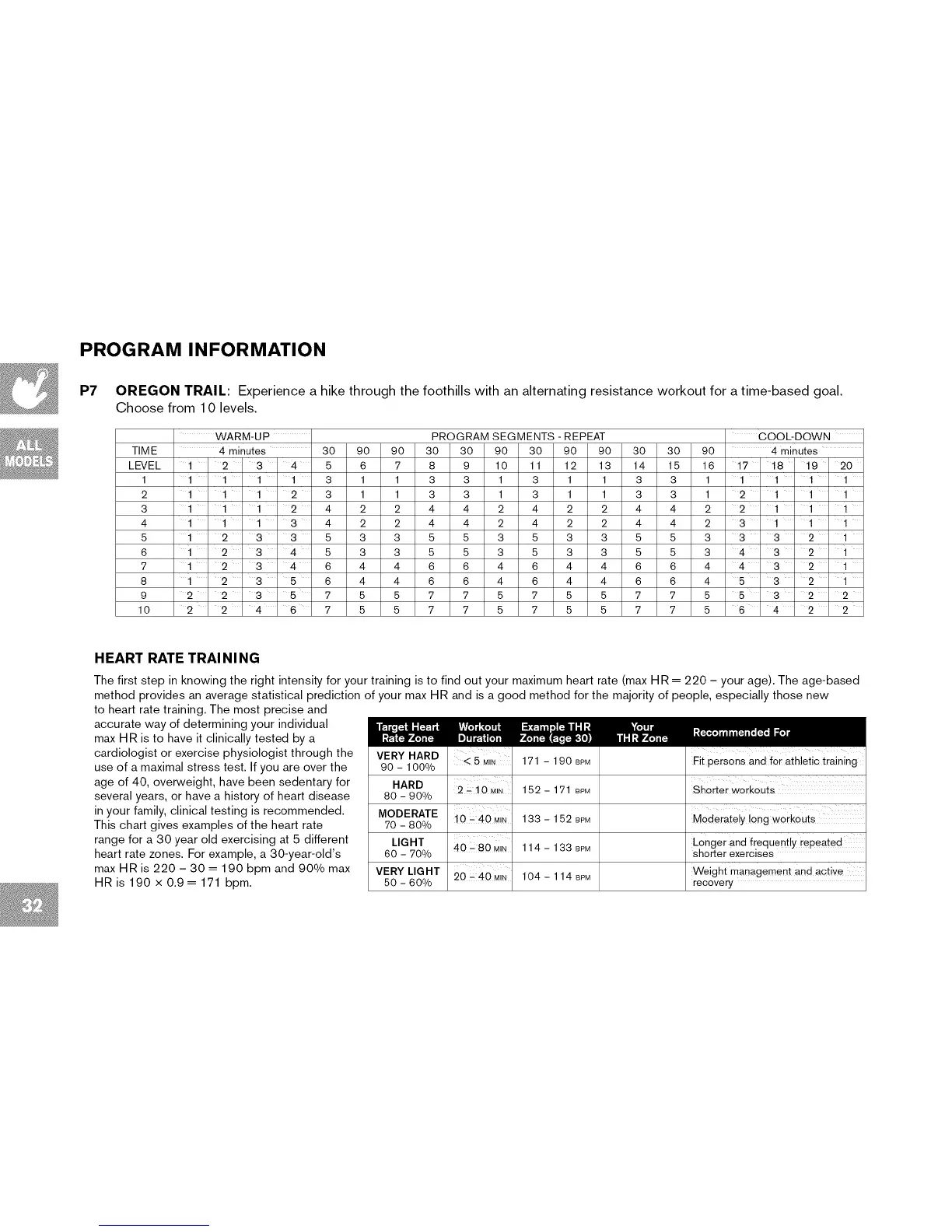
OREGON TRAIL: Experience a hike through the foothills with an alternating resistance workout for a time-based goal.
Choose from 10 levels.
WARM-UP PROGRAM SEGMENTS - REPEAT COOL-DOWN
TIME 4 minutes 30 90 90 30 30 90 30 90 90 30 30 90 4 minutes
LEVEL 1 2 3 4 5 6 7 8 9 10 11 12 13 14 15 16 17 18 19 20
1 1 ' 1 ' 1 1 3 1 1 3 3 1 3 1 1 3 3 1 1 1 1 1
2 1 ' 1 ' 1 2 3 1 1 3 3 1 3 1 1 3 3 1 2 1 1 1
3 1 ' 1 ' 1 2 4 2 2 4 4 2 4 2 2 4 4 2 2 1 1 1
4 1 1 ' 1 3 4 2 2 4 4 2 4 2 2 4 4 2 3 1 1 1
5 1 2 3 3 5 3 3 5 5 3 5 3 3 5 5 3 3 3 2 ' 1
6 1 2 ' 3 4 5 3 3 5 5 3 5 3 3 5 5 3 4 3 2 1
7 1 2 ' 3 4 6 4 4 6 6 4 6 4 4 6 6 4 4 3 2 1
8 1 2 3 5 6 4 4 6 6 4 6 4 4 6 6 4 5 3 2 1
9 2 2 3 5 7 5 5 7 7 5 7 5 5 7 7 5 5 3 2 2
10 2 2 4 6 7 5 5 7 7 5 7 5 5 7 7 5 6 4 2 2
HEART RATE TRAI NI NG
The first step in knowing the right intensity for your training is to find out your maximum heart rate (max HR = 220 - your age). The age-based
method provides an average statistical prediction of your max HR and is a good method for the majority of people, especially those new
to heart rate training. The most precise and
accurate way of determining your individual
max HR is to have it clinically tested by a
cardiologist or exercise physiologist through the
use of a maximal stress test. If you are over the
age of 40, overweight, have been sedentary for
several years, or have a history of heart disease
in your family, clinical testing is recommended.
This chart gives examples of the heart rate
range for a 30 year old exercising at 5 different
heart rate zones. For example, a 30-year-old's
max HR is 220 - 30 = 190 bpm and 900/0 max
HR is 190 x 0.9= 171 bpm.
VERY HARD 171 - 190 BPM
90 - 100%
HARD
2 - 10 M_N 152 - 171 BPM
80 - 90%
MODERATE tO L40 MIN 133 - 152 BPM
70 - 800/0
LIGHT 40- 80 MIN 114- 133 BPM
60 - 70%
VERY LIGHT 20 _ 40 M,N 104- 114 BPM
50 - 60%
Fit persons and for athletic training
Shorter workouts
Moderately long workouts
Longer and frequently repeated
shorter exercises
Weight management and active
recovery


 To Next Page
 Loading...