Chapter 7: Building the Trunk with the Default 10Gbps Stacking Ports
142
Introduction
This chapter contains instructions for building the stack using the default
10Gbps stacking ports. The procedure does not require any configuration
steps because the stacking feature is enabled by default. The default
stacking ports are:
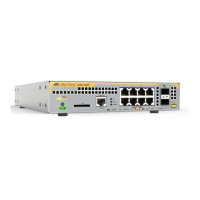
Ports 9 and 10 on the GS980MX/10HSm
Ports 17 and 18 on the GS980MX/18HSm
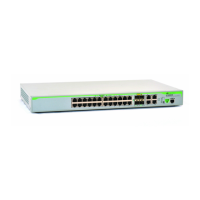
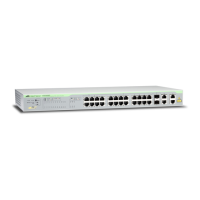
Ports 27 and 28 on the GS980MX/28 and GS980MX/28PSm
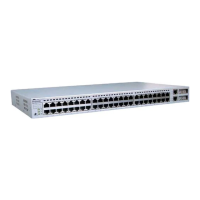
Ports 51 and 52 on the GS980MX/52 and GS980MX/52PSm
To build the stack, you cable the stacking ports and power on the
switches.
There are two procedures:
To control the assignment of the switch ID numbers yourself,
perform “Powering On the Switches Individually” on page 144. The
numbers are assigned in the order in which you power on the units.
To have the switches assign the ID numbers automatically, perform
“Powering On the Switches Simultaneously” on page 148.
After the ID numbers are assigned, you may change them with the
STACK_RENUMBER command, described in the Command Reference:
GS980MX Series Switches Running AlliedWare Plus v5.5.1 at
www.alliedtelesis.com/library.
Caution
Do not change the ID numbers of the switches after beginning to
configure the parameter settings. Otherwise, the stack might assign
configuration settings to the wrong units.
Note
To build a stack of GS980MX/10HSm, GS980MX/28PSm or
GS980MX/52PSm switches using the 5Gbps multi-speed ports for
the stack trunk instead of the default ports, refer to Chapter 8,
“Configuring the Master of the Stack Trunk with 5Gbps Multi-Speed
Ports” on page 161 and Chapter 9, “Configuring the Member(s) of
the Stack Trunk with 5Gbps Multi-Speed Ports” on page 199. For
background information, refer to “Stack Trunks” on page 63.


 To Next Page
 Loading...