GS980MX Series Installation Guide for Virtual Chassis Stacking
61
Stacking Guidelines
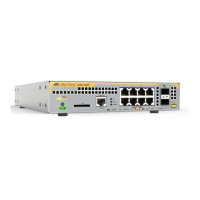
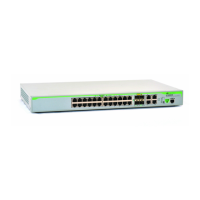
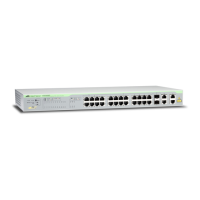
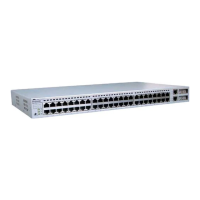
This section lists the general guidelines to building a VCStack of
GS980MX Series switches.
A stack can have up to four GS980MX Series switches.
No additional software or licenses are required for stacking within
the GS980MX Series.
Stacking is enabled by default on GS980MX Series switches.
The switches of a stack must be connected with a stack trunk,
consisting of a minimum of two ports per switch.
The default stacking SFP+ ports are:
– GS980MX/10HSm: 9 and 10
– GS980MX/18HSm: ports 17 and 18
– GS980MX/28 and GS980MX/28PSm: ports 27 and 28
– GS980MX/52 and GS980MX/52PSm: ports 51 and 52
You can increase the bandwidth and resiliency of the stack trunk
by also using the following additional SFP+ ports for stacking.
– GS980MX/28 and GS980MX/28PSmm: ports 25 and 26
– GS980MX/52 and GS980MX/52PSm: ports 49 and 50
– GS980MX/10HSm and GS980MX/18HSm do not have
additional SFP+ ports
Although the SFP+ ports support both 1Gbps SFP and 10 Gbps
SFP+ transceivers, stack trunks require 10Gbps transceivers.
Stack trunks are not supported with 1Gbps transceivers.
Stack trunks on the GS980MX/10HSm, GS980MX/18HSm,
GS980MX/28PSm, and GS980MX/52PSm can also be built with
the multi-speed 5Gbps ports.
The switches of a stack can be the same or different GS980MX
Series models.
A stack of GS980MX Series switches cannot contain other
stacking switches, such as x930 or x950 Series switches.
The links of a stack trunk must be direct connections between
switches. You cannot install a networking device, such as a media
converter or Ethernet switch, between two stacking ports.
SFP+ transceivers and direct attach cables used for a stack trunk
must be from Allied Telesis. Switches will not form a stack with
transceivers from other network equipment providers. For a list of
supported transceivers, refer to the product data sheet on the
Allied Telesis web site.


 To Next Page
 Loading...