Overview
4
Auto MDI/MDI-X
An RJ-45 twisted pair port on a 10 Mbps or 100 Mbps Ethernet network device
can have one of two possible wiring configurations: MDI or MDI-X. The RJ-45
port on a PC, router, or bridge is typically wired as MDI, while the twisted pair
port on a switch or hub is usually MDI-X.
To connect two 10 Mbps or 100 Mbps network devices together that have
dissimilar port wiring configurations, such as MDI to MDI-X, you use a
straight-through twisted pair cable. To connect two network devices that have
the same wiring configuration, such as MDI to MDI, you use a crossover cable.
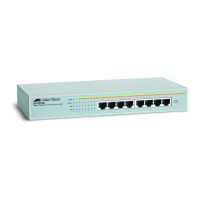
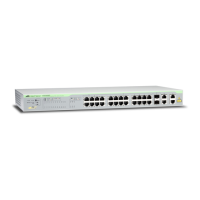
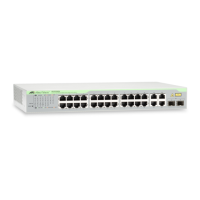
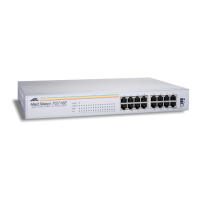
The AT-FS716, AT-FS716E, and AT-FS724i switches have auto MDI/MDI-X on
all ports. Auto MDI/MDI-X automatically determines the configuration of the
port on the end-node to which it is connected and then configures itself
appropriately. For example, if a port on a switch is connected to a port on a
bridge, which is typically wired as MDI, the port on the switch automatically
configures itself as MDI-X. This feature allows you to use a straight-through or
a crossover cable when connecting end-nodes to the switch.
Auto-negotiation
Auto-negotiation determines the duplex mode of the ports. The duplex mode
refers to the manner in which an end-node sends and receives data on the
network. Depending on its capabilities, an end-node can operate in either half-
or full-duplex mode. An end-node operating in half-duplex can either send or
receive data, but not both at the same time. However, an end-node operating in
full-duplex can send and receive data simultaneously. The best network
performance is achieved when an end-node can operate in full-duplex mode.
The AT-FS716 Series and AT-FS724i switches can operate in either full- or
half-duplex mode.


 To Next Page
 Loading...