EasyManua.ls Logo

Altec 19 Walnut - Speaker System Usage and Maintenance; Electrical Connections; Grille Removal and Installation; Frequency Control Adjustments

Altec 19 Walnut
4 pages
Print Icon
To Next Page IconTo Next Page
To Previous Page IconTo Previous Page
Loading...
Electrical
Connections
Two
terminals
at
the
underside
of
the
cabinet
connect
leads
from
the
amplifier.
If
more
than
one
Studio
Monitor
Speaker
System
is
connected
to
the
amplifier(s),
be
sure
to
observe
polarity
so
that
proper
acoustic
phasing
is
achieved.
Removal
of
Grilles
‘Push-and-lock’
fasteners
secure
each
grille
to
the
cabinet.
To
remove
a
grille,
simply
grasp
the
upper
corners
and
pull
firmly
outward.
To
put
the
grille
back
on,
align
it
with
the
cabinet
and
press
each
corner
until
firmly
seated.
For
the
Model
15,
also
press
the
center
of
the
grille,
just
below
the
horn
area,
to
engage
the
central
fastener.
Frequency
Controls
Two
frequency
controls
are
located
on
the
network/equalizer
assembly,
behind
the
grille
(lower
grille
for
the
Model
19.
When
the
controls
are
positioned
in
the
OPTI¬
MUM
area
of
adjustment,
a
‘flat’
fre¬
quency
response
Is
obtained
for
most
acoustic
environments.
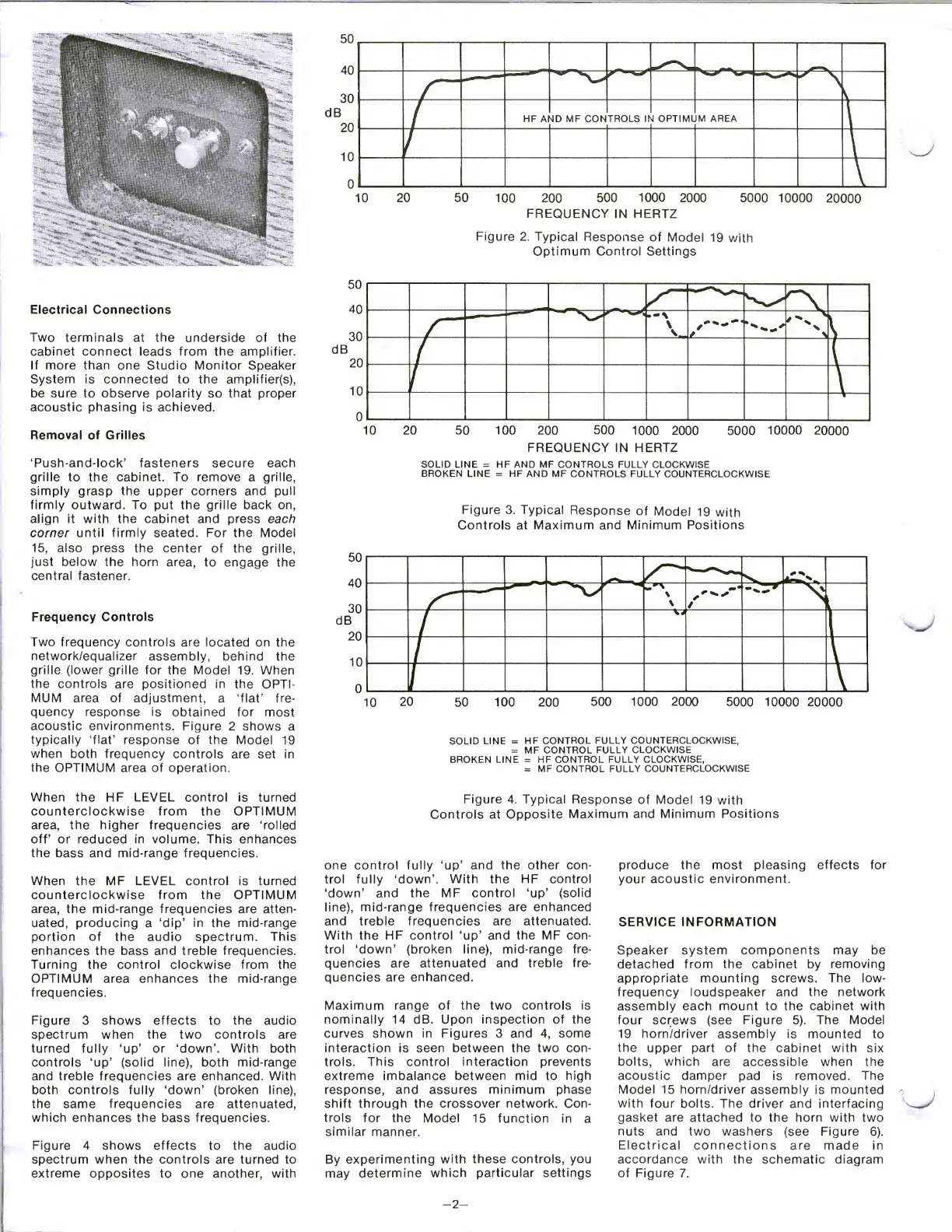
Figure
2
shows
a
typically
‘flat’
response
of
the
Model
19
when
both
frequency
controls
are
set
in
the
OPTIMUM
area
of
operation.
When
the
HF
LEVEL
control
is
turned
counterclockwise
from
the
OPTIMUM
area,
the
higher
frequencies
are
‘rolled
off’
or
reduced
in
volume.
This
enhances
the
bass
and
mid-range
frequencies.
When
the
MF
LEVEL
control
is
turned
counterclockwise
from
the
OPTIMUM
area,
the
mid-range
frequencies
are
atten¬
uated,
producing
a
‘dip’
in
the
mid-range
portion
of
the
audio
spectrum.
This
enhances
the
bass
and
treble
frequencies.
Turning
the
control
clockwise
from
the
OPTIMUM
area
enhances
the
mid-range
frequencies.
Figure
3
shows
effects
to
the
audio
spectrum
when
the
two
controls
are
turned
fully
‘up’
or
‘down’.
With
both
controls
‘up’
(solid
line),
both
mid-range
and
treble
frequencies
are
enhanced.
With
both
controls
fully
‘down’
(broken
line),
the
same
frequencies
are
attenuated,
which
enhances
the
bass
frequencies.
Figure
4
shows
effects
to
the
audio
spectrum
when
the
controls
are
turned
to
extreme
opposites
to
one
another,
with
HF
Al
MD
MF
CON
TROLS
n
4
OPTIML
IM
AREA
10
20
50
100
200
500
1000
2000
5000
10000
20000
FREQUENCY
IN
HERTZ
Figure
2.
Typical
Response
of
Model
19
with
Optimum
Control
Settings
10
20
50
100
200
500
1000
2000
5000
10000
20000
FREQUENCY
IN
HERTZ
SOLID
LINE
=
HF
AND
MF
CONTROLS
FULLY
CLOCKWISE
BROKEN
LINE
=
HF
AND
MF
CONTROLS
FULLY
COUNTERCLOCKWISE
Figure
3.
Typical
Response
of
Model
19
with
Controls
at
Maximum
and
Minimum
Positions
10
20
50
100
200
500
1000
2000
5000
10000
20000
SOLID
LINE
=
HF
CONTROL
FULLY
COUNTERCLOCKWISE,
=
MF
CONTROL
FULLY
CLOCKWISE
BROKEN
LINE
=
HF
CONTROL
FULLY
CLOCKWISE,
=
MF
CONTROL
FULLY
COUNTERCLOCKWISE
Figure
4.
Typical
Response
of
Model
19
with
Controls
at
Opposite
Maximum
and
Minimum
Positions
one
control
fully
‘up’
and
the
other
con¬
trol
fully
‘down’.
With
the
HF
control
‘down’
and
the
MF
control
‘up’
(solid
line),
mid-range
frequencies
are
enhanced
and
treble
frequencies
are
attenuated.
With
the
HF
control
‘up’
and
the
MF
con¬
trol
‘down’
(broken
line),
mid-range
fre¬
quencies
are
attenuated
and
treble
fre¬
quencies
are
enhanced.
Maximum
range
of
the
two
controls
is
nominally
14
dB.
Upon
inspection
of
the
curves
shown
in
Figures
3
and
4,
some
interaction
is
seen
between
the
two
con¬
trols.
This
control
interaction
prevents
extreme
imbalance
between
mid
to
high
response,
and
assures
minimum
phase
shift
through
the
crossover
network.
Con¬
trols
for
the
Model
15
function
in
a
similar
manner.
By
experimenting
with
these
controls,
you
may
determine
which
particular
settings
produce
the
most
pleasing
effects
for
your
acoustic
environment.
SERVICE
INFORMATION
Speaker
system
components
may
be
detached
from
the
cabinet
by
removing
appropriate
mounting
screws.
The
low-
frequency
loudspeaker
and
the
network
assembly
each
mount
to
the
cabinet
with
four
screws
(see
Figure
5).
The
Model
19
horn/driver
assembly
is
mounted
to
the
upper
part
of
the
cabinet
with
six
bolts,
which
are
accessible
when
the
acoustic
damper
pad
is
removed.
The
Model
15
horn/driver
assembly
is
mounted
with
four
bolts.
The
driver
and
interfacing
gasket
are
attached
to
the
horn
with
two
nuts
and
two
washers
(see
Figure
6).
Electrical
connections
are
made
in
accordance
with
the
schematic
diagram
of
Figure
7.
-
2
-

Related product manuals