4 N5X Construction guide
Capacitors
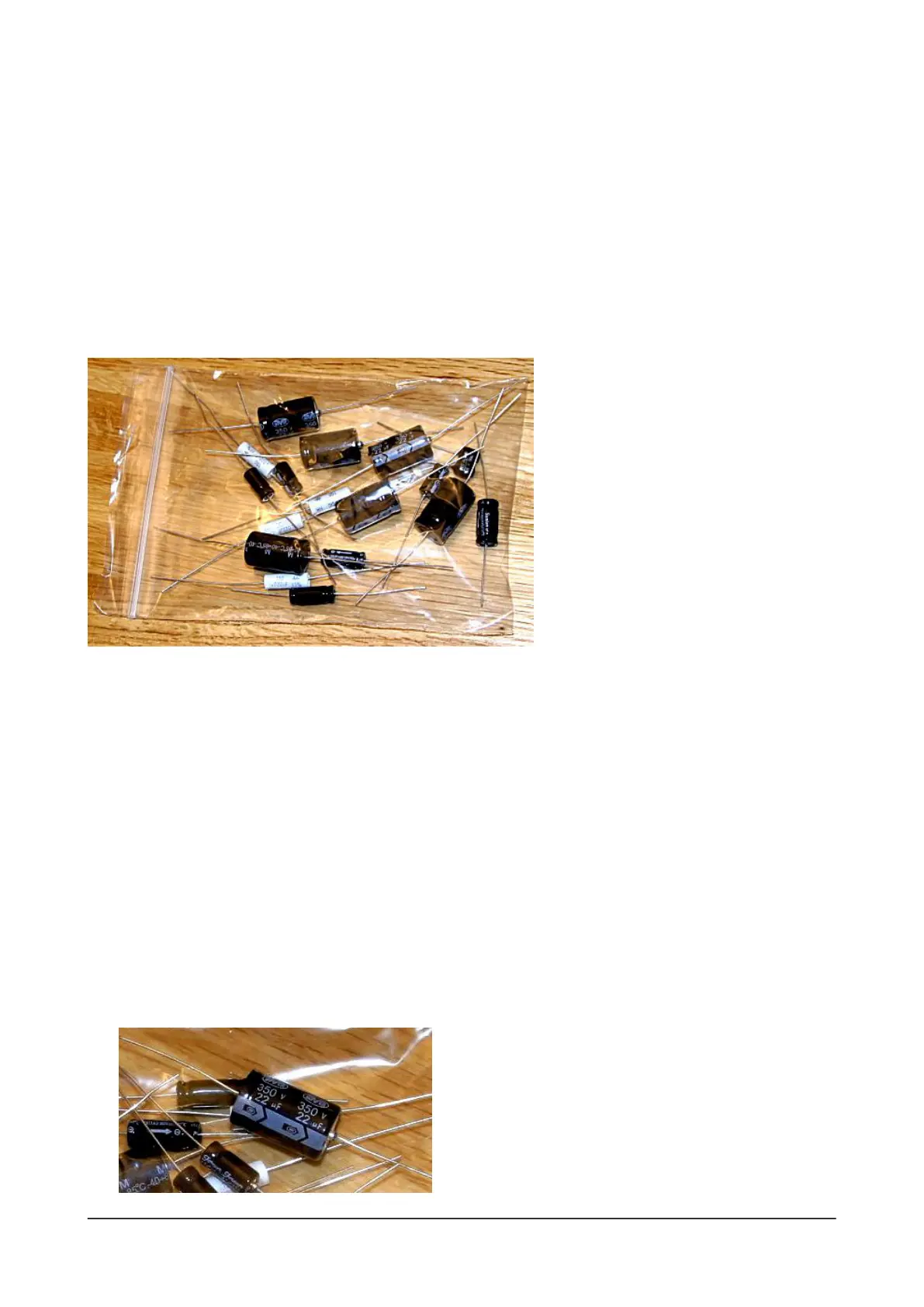
Almost all modern capacitors have their values and ratings printed somewhere on their body. This
written information makes it easy to work out which capacitor is which. (There is a colour coding system
for certain types of small capacitor but none of those are included in this project.)
The rst part of the text is the capacitance value itself. This is shown in units of microFarads (uF),
nanoFarads (nF) or picoFarad (pF). When comparing what you see with the Kit contents list bear in mind
that 1000pF = 1nF = 0.001uF. The smallest caps are the silver mica ones, usually reddish brown or tan in
colour. These may not have a unit printed, but these capacitors are always in the picoFarad range, so
"500 500V" means 500pF.
You'll also see from the printed information that capacitors have a voltage rating. This is a maximum
working voltage for the component, and it's very important. Whereas all of the resistors in your kit are
rated well over the maximum voltage present inside any part of this amplier, it's a dierent story for the
capacitors. They are all specied and rated according to their place in the circuit and the voltages
present in that position.
For example, the large power supply capacitors will be faced with the highest voltages in your amp -
which can be almost 300V. So these capacitors must be rated for at least this voltage; the parts
supplied with your kit are rated at 350V or more (see below). This is plenty. Likewise, there are some
signal caps inside the amplier that are rated at 500V and 630V - more than enough.
Not all capacitors need to be rated at such a high voltage. And it would be very wasteful of money
and space to have every capacitor rated for the full voltage range of the amplier. For example,
capacitor C1 is rated according to its position at the cathode of the ECC83 preamp valve, and it never
undergoes a high voltage - perhaps 2V at most. So any rating of 25V or more is ne (I usually supply
100V as they are far more readily available, and still quite small). Capacitors may have voltage ratings
higher than specied above (depending on supplies).


 To Next Page
 Loading...