on both sides of the tympanic membrane. The changing compliance with
pressure is displayed as a graph.
3.3. Stapedial reflex measurement
Using the same principle it is also possible to establish whether a stapedial
reflex is present. In this case, the 226Hz tone is used to measure the
compliance of the ear, while a short tone at a different frequency is
presented (the reflex stimulus). The level of this stimulus is increased in
steps until the stapedial muscles respond causing the tympanic membrane
to become stiffer, or a preset maximum level is reached. When the change
in compliance exceeds a predetermined threshold this constitutes a reflex
and the change in compliance at that level when the stimulus is applied is
displayed as a plot against time.
The stapedial reflex is measured at the static ear canal pressure that
produces the maximum membrane compliance, so reflex measurements
are taken after the tympanogram is measured when the peak compliance
pressure has been established.
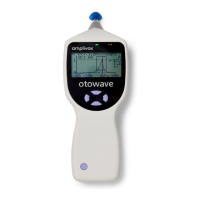
The Otowave model 102-1 measures stapedial reflex at 1000Hz, while the
model 102-4 measures at 500Hz, 1000Hz, 2000Hz and 4000Hz. The
maximum level for the reflex stimulus may be preset, along with the step
size in dB between the three preceding lower levels of stimulus (see
Section 5.5).
4. Using the Otowave
This instrument is equipped with a real-time clock.
Before use, please set the date & time to local values
in order to ensure that test data and calibration status
are correctly identified. Refer to Section 12.2.
4.1. Installing & replacing batteries
The Otowave 102 may be powered from Alkaline ‘AA’ batteries or
rechargeable Nickel-Metal Hydride (NiMH) batteries (see Section 14). Four
batteries are required. Do not mix battery types or old and new batteries.
If the Otowave is to be used infrequently the use of alkaline cells is
recommended. NiMH batteries have a high self-discharge rate and are
likely to need recharging if left unused for several weeks.


 To Next Page
 Loading...