7
CALCULATION EXAMPLE FOR OPERATING TIME AS A DIRECT CURRENT SOURCE:
Battery capacity of the power pack: 18 Ah
Power consumption of the connected consumer (example): 2.5 A
18 Ah
____
= 7,2 h
2,5 A
Operating time/result: 7.2 h (hours)
(These values are, of course, only guidelines and refer to a sound, completely charged battery.)
6.8. USING AS A 12 V VOLTAGE SUPPLY
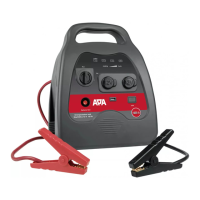
The power pack can be used as a 12 V DC source for many devices that can be operated with 12 V DC and a cigarette lighter plug. Plug the
cigarette lighter plug of the device you wish to operated into one of the 12 V sockets (Position 5 in the overview). The device you wish to operate
should not require a current greater than 10 A. The outlets of the power pack have an automatic fuse that will deactivate the device at a current
greater than 10 A. If the unit is switched o, immediately disconnect the power pack from the device to be operated. After approximately three
minutes, the fuse will free the outlets for use.
6.6. ATTEMPTING TO START
Use the rotary switch (Position 2 in the overview) to switch on the jump-start function. Start the motor. Do not operate the starter for longer
than 6 seconds. The battery of the power pack is not designed for longer starting attempts. Pause for at least 5 minutes between two starting
attempts. If the motor does not start after a number of attempts, abort the jump-start process and investigate the cause of the defect.
6.5 CONNECTING THE POWER PACK VEHICLES WITH NEGATIVE EARTH
Switch o the ignition and all electrical consumers of the vehicle (radio, lights, rear window heating, seat heating etc.). Apply the parking brake.
Make sure that the power pack‘s jump-start rotary switch (Position 2 in the overview) is set to „OFF“.
First connect the red (+) pole callipers (Position 1 in the overview) to the plus pole of your vehicle battery. The black (-) pole callipers (Position
10 in the overview) is connected, as far as possible from the battery, to the motor block or chassis (not to a painted part).
6.7. REMOVING THE POWER PACK
Switch o the jump-start function with the rotary switch (Position 2 in the overview). First disconnect the black (-) pole calliper, coil the cable
and attach the pole calliper to the designated holder. Then disconnect the red (+) pole calliper, coil the cable and attach the pole calliper to the
designated holder.
Always maintain this sequence.
Recharge the power pack.
7. MAINTENANCE AND CARE
Maintenance: Store the power pack at room temperature. The battery will discharge even when not in use. If the power pack is not used for a
longer period of time, it must be recharged for ve hours. In winter, recharge every six weeks, in summer recharge every four weeks.
Care: Clean the housing of the power pack with a soft, dry cloth. Do not use any aggressive cleaning agents or solvent-based cleaners. Never
allow liquids to ingress into the housing.
6.9. USING AS A USB CHARGER
You can also use the power pack as a USB charger. To do this, connect your smartphone, MP3 player, etc. to the USB output (Position
7 in the overview). Switch on the USB output with the switch (Position 8 in the overview), the control light below the USB output
lights up. After charging, turn o the USB output and remove your device from the USB output.
9. CONTACT INFORMATION
EAL GmbH
Otto-Hausmann-Ring 107
42115 Wuppertal, Germany
+49 (0)202 42 92 83 0
+49 (0) 202 42 92 83 – 160
info@eal-vertrieb.com
www.eal-vertrieb.com
8. NOTES REGARDING ENVIRONMENTAL PROTECTION
Do not dispose of electrical devices with the household waste! Electrical and electronic scrap must be collected separately and
disposed of in an environmentally responsible manner for recycling. Please contact your community or city administration re-
garding disposal options for electrical and electronic scrap.
You are legally obliged to return batteries and battery packs. After use, they may be returned to us, handed in to a communal
collection point, or to a local dealer. Batteries containing hazardous materials are labelled with a symbol consisting of a crossed
out trash can and the chemical symbol (Cd, Hg or Pb) which designates the heavy metal responsible for the hazard.
Pb


 To Next Page
 Loading...