
 Need help?
Do you have a question about the Apera Instruments 201DJ-C and is the answer not in the manual?
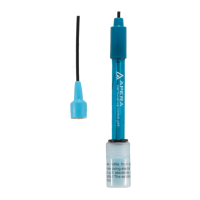
The Apera Instruments 201DJ-C Double-Junction pH Electrode is a specialized tool designed for precise pH measurement in various aqueous solutions. Its core function revolves around accurately determining the acidity or alkalinity of a sample, making it suitable for a wide range of applications from environmental monitoring to industrial process control. The electrode incorporates a proprietary lithium glass membrane, a key component that facilitates fast and stable readings. This advanced membrane technology is crucial for obtaining reliable results efficiently, especially in dynamic or time-sensitive testing scenarios.
A significant design feature of this electrode is its double-junction structure. This innovative construction is specifically engineered to minimize the common issue of junction clogging, which can often plague conventional pH electrodes. By reducing the likelihood of clogging, the 201DJ-C maintains consistent performance and extends its operational lifespan, particularly when used in challenging sample matrices. The internal reference solution, a gel-based potassium chloride (KCL) formulation, is another practical aspect of its design. Unlike electrodes that require frequent refilling of their reference solution, the gel KCL in the 201DJ-C is maintenance-free in this regard, simplifying its use and reducing the overall effort required for upkeep.
The electrode is particularly well-suited for testing in complex water solutions. This includes environments such as wastewater, where the presence of various contaminants can interfere with standard pH measurements, and pool water, which often contains chemicals that can affect electrode performance. Beyond these specific applications, it also performs effectively in general water solutions, making it a versatile instrument for a broad spectrum of users. However, it's important to note that while robust, the electrode may not perform optimally in certain extreme conditions. For instance, long-term testing in high-temperature solutions (above 122°F or 60°C) can impact its performance. Similarly, frequent exposure to strong alkaline solutions (above 12 pH) or highly acidic solutions (below 2 pH) may also affect its longevity and accuracy. Users should also be aware that the electrode might not yield the best results in low ionic strength solutions, such as distilled or deionized water, due to the inherent challenges these solutions pose for pH sensing. Furthermore, testing caustic solutions that could erode the polycarbonate housing of the electrode should be avoided to prevent damage.
Installation of the 201DJ-C pH electrode is straightforward. It connects to a pH meter via a standard BNC connector. Users simply locate the BNC socket on their pH meter, remove any protective caps, and then insert the blue BNC connector of the electrode, twisting it clockwise until it securely locks into place. After installation, a crucial step for ensuring accuracy is to perform a 3-point calibration. This calibration process helps the meter recognize the new electrode and adjust its readings to provide precise measurements.
Before each measurement, proper handling of the electrode is essential. The electrode comes with a storage cap containing a specific storage solution, which keeps the pH glass sensor tip hydrated and sensitive. To prepare for measurement, the user loosens the bottle cap, then carefully pulls out the electrode with a counterclockwise twist, placing the storage bottle in a safe location. The electrode should then be rinsed with purified water to remove any residual storage solution. Excess water can be gently shaken off or blotted dry with a clean tissue or filter paper; it is critical never to rub the delicate glass membrane, as this can damage it. When taking a measurement, the electrode is inserted into the sample solution and stirred for a few seconds. This action helps to dislodge any potential air bubbles that might cling to the sensor, which could otherwise lead to unstable readings. Once the reading stabilizes, the measurement can be taken. After use, the electrode must be returned to its storage bottle by twisting it clockwise into the cap and then tightening the cap. If the KCL storage solution in the cap becomes contaminated, it should be replaced with new storage solution (SKU: AI1107). It's important to use the specified storage solution, as other brands may not be compatible or effective for this electrode.
Maintenance is key to prolonging the life and ensuring the accuracy of the 201DJ-C electrode. A fundamental maintenance practice is to always rinse the glass bulb sensor with purified water (distilled or deionized water) both before and after every test and calibration. This helps to remove general contaminants and prevents buildup. For more stubborn general contaminants, a gentle cleaning with warm soap water and a soft brush can be effective. However, for specific types of contaminants, specialized cleaning solutions are recommended. For instance, inorganic metal oxides can be cleaned with dilute acid (less than 1mol/L). Organic lipids respond well to dilute detergent (weak alkaline solutions). Resin macromolecules can be removed using dilute alcohol, acetone, or ether. Proteinaceous and hematocyte sediments require an acidic enzymatic solution, such as one made from saccharated yeast tablets. For paints, a dilute bleacher or peroxide solution is recommended.
Beyond cleaning, several other maintenance practices are crucial. The glass bulb sensor must always be covered by the KCL storage solution (SKU: AI1107) in the storage cap when the electrode is not in use. This prevents the sensor from drying out, which can significantly impair its performance and lifespan. A critical warning is never to store pH electrodes in pure water, such as RO water, tap water, distilled water, or deionized water. Storing in pure water can cause irreversible damage to the electrode by leaching out the ions from the reference solution. The electrode connector should also be kept clean and dry. If it becomes dirty, it can be cleaned with cotton balls soaked in isopropyl alcohol and then thoroughly blow-dried. This prevents potential short circuits that could undermine the electrode's performance.
It's important for users to understand that pH electrodes, including the 201DJ-C, have a finite lifespan. They naturally age through normal use and will eventually fail. The typical service life for a pH electrode is generally between 1 to 2 years. Signs that an electrode may need replacement include a significantly slower response time or a slope value lower than 90% during calibration (many Apera portable/benchtop pH meters display this slope data between calibration points). Replacing the electrode when these signs appear is crucial for maintaining measurement accuracy and reliability.
 General
| Model | 201DJ-C |
|---|---|
| Category | Laboratory Equipment |
| Type | pH Meter |
| Resolution | 0.01 pH |
| Accuracy | ±0.01 pH |
| Power Supply | 4 x 1.5V AAA batteries |
| Junction | Ceramic |
| Reference System | Ag/AgCl |
| Body Material | ABS plastic |
| pH Range | 0 to 14 |
| Calibration | Up to 3 points |
| Temperature Compensation | Automatic |
| Electrode Type | Combination |
| Electrolyte | KCl |

 To Next Page