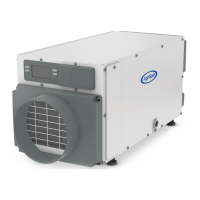
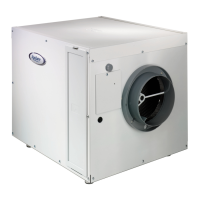
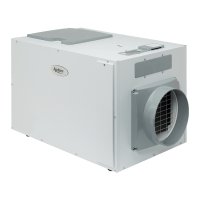
A
C
D
FIGURE 14: CAPPED DRAIN ACCESS FOR CLEANING
90-2693
INSTALLING THE DRAIN
USING HARD PIPE
• Install a 3/4” PVC slip x 3/4” MNPT PVC tting to the
dehumidier and use 3/4” nominal PVC Schedule 40 pipe to
run the condensate line to the nearest oor drain or to an
outside location that slopes away from the building.
• Always maintain a constant downward slope in drain piping.
Ensure that drain tubing does not interfere with removal of
the side panel or lter door.
• Do not use metal ttings and only hand-tighten threaded
ttings. PTFE thread seal tape is recommended for threaded
connections.
• Install a tee or three-way elbow at the dehumidier outlet
with a small, capped vertical tube (do not cement cap in
place) to allow for cleaner to be poured into the drain line
(see FIGURE 14).
• PVC primer and cement is recommended for slip-t
connections (do not cement threaded connections).
USING FLEXIBLE TUBING
• Install the provided 3/4” NPT x 3/4” hose barb tting and use
3/4” I.D. exible drain tubing. Hand-tighten the tting to the
dehumidier. PTFE thread seal tape is recommended for
threaded connections.
• Always maintain a constant downward slope from the
dehumidier to the nearest oor drain or condensate pump,
and do not allow soft tubing to curl up, which may result in
air lock.
A. CAP
B. SMALL SECTION OF DRAIN TUBE
C. 3/4” 3-WAY ELBOW OR TEE AND ELBOW
D. CONDENSATE DRAIN LINE
INSTALLING DUCTWORK
• Use insulated duct when the dehumidier is located in an
unconditioned space, such as an attic, garage or crawl
space, or if connecting a fresh air duct to the dehumidier
ductwork.
• Use zip ties, mastic, and tape as needed to seal the duct
connections to the dehumidier and to seal the insulation
sleeves to prevent condensation inside the ductwork.
Connecting the dehumidier to your HVAC system will pull
air to be dehumidied from the whole home and similarly
will discharge air to the whole home. Make sure the duct system
pressure the dehumidier will have to operate against does not
exceed 0.4” Water Column (w.c.) for Model E080 and 0.6” w.c.
for Models E100/E100H. Measure the system pressure when the
HVAC fan is operating at the highest airow (speed) setting.
There are not always readily available locations on the HVAC
duct system for connecting 10” ducts, and some local codes
do not allow ducting to the return side of the HVAC system.
If so, another option is to install just the discharge of the
dehumidier to the HVAC system (see FIGURE 16 and FIGURE 17)
or to use dedicated registers for both the inlet and discharge of
the dehumidier (see FIGURE 18).
9



 To Next Page
 Loading...