Need help?
Do you have a question about the argon audio SUB640 and is the answer not in the manual?
Welcomes the user and expresses hope for enjoyment from the Argon Audio Subwoofer.
Guidance on safely unpacking the subwoofer and checking for any damage from transport.
Instructions for safe installation, emphasizing reading manuals and connecting to mains power.
Recommendations for placing the subwoofer in listening rooms to achieve desired sound.
Recommended break-in time for the subwoofer's drive units to settle and perform optimally.
Detailed instructions on connecting the subwoofer to amplifiers with or without SUB-OUT.
Guidance on adjusting volume, frequency, phase, and understanding auto standby function.
Instructions on how to properly clean and maintain the subwoofer's cabinet and grille.
Information on WEEE/RoHS compliance and critical safety warnings for product usage.
Detailed explanation of the rear panel controls, inputs, outputs, and power connections.
Lists key technical details including cabinet type, driver size, frequency response, and output power.
Provides solutions for common problems such as no power or no sound from the subwoofer.
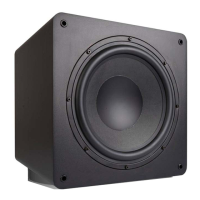
The Argon SUB640 is a subwoofer designed to enhance the low-frequency performance of your audio system, whether it's a stereo setup or a multi-channel surround sound configuration. It is built with a focus on quality components and a solid cabinet, aiming to deliver strong bass without unnecessary frills.
The primary function of the Argon SUB640 is to reproduce low-frequency sounds (bass) that full-range loudspeakers may struggle with. By adding a subwoofer, your main speakers can focus on mid-range and high frequencies, leading to a more balanced and impactful sound experience. The SUB640 features an integrated amplifier, meaning it is an active subwoofer that requires a direct connection to a power source. It offers adjustable controls for volume, crossover frequency, and phase, allowing you to fine-tune its output to seamlessly integrate with your existing speakers and room acoustics.
The subwoofer can be connected to your audio system in two main ways. The preferred method is via a dedicated SUB-OUT or PRE-OUT connection on your amplifier or AV receiver, using an RCA/phono cable. This provides a low-level signal specifically designed for subwoofers. In cases where your amplifier lacks such an output, the SUB640 also offers high-level speaker inputs, allowing you to connect it directly to your amplifier's speaker outputs. However, this is considered an emergency solution, as most modern amplifiers provide a dedicated subwoofer output.
A notable feature of the SUB640 is its built-in AUTO STANDBY function. After approximately 10 minutes of no input signal, the subwoofer will automatically switch to a standby mode, indicated by a change in the LED color. When an input signal is detected again, it will automatically become active. This feature helps conserve energy and ensures the subwoofer is ready when needed without manual intervention. For continuous operation, the AUTO standby function can be overridden by setting the power switch to the "ON" position.
Upon unpacking, it's recommended to inspect the subwoofer for any transport damage and to retain the original packaging for future shipping needs. Before connecting, ensure both the subwoofer and your amplifier are switched off.
For optimal performance, the SUB640 benefits from a "running-in" period of approximately 15-20 hours at normal listening levels. During this time, the drive units will settle, allowing the subwoofer to perform as intended. It's advisable to finalize its positioning and control settings after this initial break-in period.
Positioning the subwoofer is less critical than full-range loudspeakers because low frequencies are difficult to localize in a room. However, some general guidelines can help. In a surround sound setup, the subwoofer is ideally placed between the TV and one of the front loudspeakers. For a stereo setup, it should ideally be positioned between the two front stereo speakers. Placing the subwoofer close to a wall or in a corner can enhance bass output. Ultimately, experimentation is encouraged to find the placement that sounds best in your specific listening environment.
The rear panel provides several controls for adjusting the subwoofer's performance. The "Volume" control (01) allows you to set the overall output level of the bass. The "Cross-over / Frequency adjustment" (02) determines the highest frequency the subwoofer will reproduce, allowing you to blend it smoothly with your main speakers. The "Phase adjustment" (03) helps align the subwoofer's output with your main speakers, preventing cancellation or reinforcement of bass frequencies. These controls should be adjusted to your personal preference, experimenting with different music and films to achieve the desired sound.
The power switch (09) on the rear panel allows you to turn the unit ON or OFF. When set to "AUTO," the subwoofer will enter standby mode after a period of inactivity and reactivate upon signal detection. The LED indicator (07) provides visual feedback on the subwoofer's status, glowing blue when active and changing color in standby mode.
The Argon SUB640 is designed for straightforward maintenance. For cleaning the cabinet surface, a damp soft cloth (using only cold clean water) is recommended. Avoid using any solvents or harsh cleaners, as these could damage the finish.
If the grille fabric becomes dusty, it can be cleaned with a normal clothes brush or carefully vacuumed after detaching it from the cabinet. When cleaning, it's important to avoid touching the drive unit directly to prevent damage.
To ensure the longevity of the subwoofer and for safety, it's crucial to avoid placing drinks or other liquids on top of it, as spills could damage the internal components.
If the subwoofer will not be used for an extended period, it is recommended to disconnect it from the mains supply.
In case of a blown fuse, the fuse holder (11) is accessible on the rear panel. When replacing a fuse, it is imperative to unplug the power cable from the mains socket first and to use only a fuse of the same type and value as the original. For any other issues or if the product has been damaged, it is advised not to attempt self-repair. Instead, contact the manufacturer for referral to an authorized service center to prevent exposure to dangerous voltages or other hazards.
 Power
Power| main voltage | 220-240V, 50/60Hz |
|---|---|
| output power | 1x65W (RMS) |
 Audio Specifications
| frequency response | 50Hz-200Hz |
|---|---|
| cross over frequency | 40-200Hz adjustable |
| phase regulation | 0-180 degrees |
 Weight and Dimensions
| weight | 6.5 kg |
|---|

 To Next Page