The device described in this manual is the MADERA Extendable Dining Table from ARTICLE. It is a piece of furniture designed for dining, with the key feature of being extendable to accommodate more people or provide additional surface area when needed.
Function Description:
The MADERA Extendable Dining Table serves as a central piece of furniture for dining rooms or kitchens, providing a surface for meals, gatherings, and other activities. Its primary function is to offer a stable and aesthetically pleasing dining surface. The "Extendable" aspect indicates its ability to change in length, typically by adding or removing extension leaves, thereby adapting to different space requirements and guest numbers. This adaptability makes it suitable for both everyday use and special occasions.
Important Technical Specifications (derived from parts and assembly steps):
- Components: The table consists of several key components:
- Center Bar (A): A central structural element, likely running underneath the tabletop, providing support and a mechanism for extension.
- Center Bar Attachment (B): Connects to the center bar, possibly housing a bolt for initial assembly.
- Center Bar Bracket (C): Further secures the center bar to other parts of the table structure.
- Legs (D): Two sets of legs are provided, suggesting a sturdy four-legged design. These are crucial for supporting the tabletop.
- Extension Leaf (E): Two extension leaves are included, confirming the table's extendable nature. These leaves are inserted to lengthen the table.
- Hardware: A variety of bolts, washers, and nuts are used for assembly, indicating a robust and secure construction.
- M8 x 20mm Bolt (G): Used in conjunction with the center bar attachment.
- M8 Lock Washer (H): Prevents bolts from loosening due to vibration or movement.
- M8 Washer (I): Distributes the load of a fastener, protecting the surface and ensuring a tighter fit.
- M8 x 35mm Bolt (J): Longer bolts used for securing legs or other major components.
- M6 x 20mm Bolt (K): Smaller bolts, possibly for attaching brackets or less load-bearing parts.
- M6 Lock Washer (L): Similar to M8 lock washers, but for M6 bolts.
- M6 Washer (M): Similar to M8 washers, but for M6 bolts.
- Nut (N): Used with bolts to secure components, specifically mentioned for the ends of the center bar.
- Tools Provided:
- Allen Key (F): For tightening bolts with hexagonal sockets.
- Socket Wrench (O): For tightening nuts and possibly other bolts.
- Assembly Time: Approximately 30 minutes. This suggests a relatively straightforward assembly process.
- Number of People for Assembly: 2 people are recommended, indicating that some parts might be heavy or awkward for a single person to handle.
- Difficulty: Rated as "3" (out of an unspecified scale, but typically implying moderate difficulty), suggesting that while not overly complex, it requires careful attention to instructions.
Usage Features:
- Extendable Design: The core feature is its ability to extend. This is achieved by inserting two "Extension Leaves" (E) into the table structure. The manual specifically mentions "dowels on extension leaves (E) fit into holes at the end of each extension arm," indicating a precise alignment mechanism.
- Adjustable Extension Mechanism: The manual provides "EXTENSION LEAF ADJUSTMENT INSTRUCTIONS," which is a crucial usage feature. This allows users to fine-tune the fit of the extension leaves.
- Adjustment Method: Bolts on the arms underneath the tabletop can be loosened or tightened.
- Effect of Adjustment: Loosening bolts moves the arms farther out from the table, while tightening them moves the arms farther inward.
- Troubleshooting: The instructions address common issues:
- If dowels don't fit properly, adjust the bolts.
- If bolts are too loose, arms can extend too far and come out completely.
- If bolts are too tight, arms will not extend far enough to align with dowels on the leaf.
- Specific Adjustment Points: Adjustments can be made on "the bolt on the back of the arm" and "bolts from below." This indicates multiple points of adjustment for optimal alignment.
Maintenance Features (derived from assembly and usage instructions):
- Preventative Care during Assembly: The instructions advise placing all parts on a soft, clean, and flat surface such as a carpet to prevent scratches. This highlights the importance of protecting the table's finish from the outset.
- Hardware Tightening: The use of lock washers (H, L) suggests a design intended to maintain tightness over time, but regular checks and re-tightening of bolts and nuts might be implied for long-term stability. The instruction to "Secure nuts (N) on both ends of center bar after legs are bolted to table top" emphasizes a critical step for structural integrity.
- Extension Mechanism Adjustment: The detailed instructions for adjusting the extension leaf mechanism are a key maintenance feature. This allows users to correct alignment issues that may arise from use, environmental changes, or initial assembly, ensuring the table functions correctly as an extendable unit throughout its lifespan. This proactive adjustment capability helps prevent damage to the leaves or the extension arms due to misalignment.
- Customer Support: ARTICLE provides customer care via phone (1.888.746.3455), email (service@article.com), and live chat at article.com. This is an important "maintenance" feature as it offers support for troubleshooting, parts replacement, or general inquiries, extending the usability and longevity of the product by providing expert assistance.
In summary, the MADERA Extendable Dining Table is a versatile and adaptable dining solution, designed with user-friendly assembly and a practical extension mechanism that can be adjusted for optimal performance. Its construction utilizes various hardware components for stability, and the manufacturer provides clear guidance for both initial setup and ongoing maintenance.

 Need help?
 General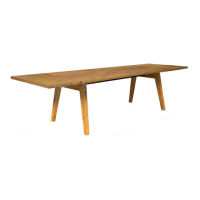

 To Next Page