WWW.ATKBINDINGS.COM | PROUDLY MADE IN ITALY SINCE 2007 31
WARNING! DANGER!
This binding model
DOES NOT COMPLY WITH ANY DIN/ISO SAFETY STANDARD NOR ANY SAFETY CERTIFICATION.
In particular, this binding does comply with DIN/ISO 11088 and/or DIN/ISO 13992 safety standards.
The release values set on the binding must be considered as INDICATIVE: the real release value may
sensibly differ from the shown one, variate during the entire life of the product and/or variate
according to the use and/or wear and tear conditions.
These bindings offer a VERTICAL RELEASE SYSTEM (My) and a LATERAL RELEASE SYSTEM (Mz), both
driven by the heel part and fully independent.
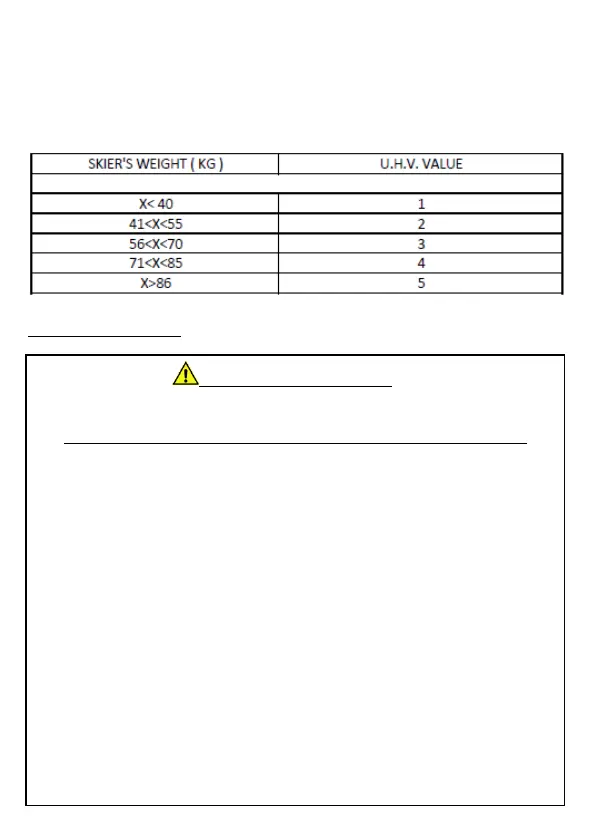
These bindings offer a release value adjustment range in between 5 and 10. Calibrating the most
suitable release value for the User’s characteristics may reduce the risk of injuries to the inferior
limbs under the femur.
Calibrating an underestimated release value could lead to undesired pre-releases of the binding or
auto-rotations of the heel during the ascent phase and increase the risk of injuries for the User.
The vertical release takes place thanks to the radial divarication of the two hooking pins under the
effect of a sufficient vertical extraction load. This release is driven by an independent elastic system.
The lateral release takes place thanks to the rotation of the heel head under the effect of a sufficient
lateral load. This release is driven by an independent elastic system.
These bindings do not provide any different release than vertical (My) and lateral (Mz) ones.
While skiing, the front locking lever of the binding must be set in “DOWNHILL MODE”. Skiing with
the front lever set in “UPHILL MODE”, the lateral release system is completely disabled, with a
greater risk for the user. (check out paragraph 4.3)
part from the ski-tip side.


 To Next Page
 Loading...