Drivin g and e nvironm e nt -
---------------=-----
•
The cooling fan can continue to run in your vehicle after the engine
is switched off . However, driv ing the vehic le to cool it down is
particularly important . During sporty driving, the engine and
brakes, the exhaust system, and the transmission all become
extremely hot . Before you park the vehicle , you should drive it for a
few miles/ki lometers at light load in the low rpm range to allow it to
coo l down. •
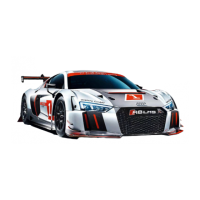
Driving on a track
Before you take your vehicle out on a track, ensure that it is in
perfect condition . For examp le, you should check the tire tread and
the brake pads. It is best to increase t ire pressure by about 0.3 bar.
When driving on a track, oil consumption may be somewhat higher
t han in "normal" operat ion =>
page 198.
You should definitely inspect your vehic le after subjecting it to
severe conditions . Are the brake pads OK? Is there anything unusual
about the tires , inc luding the inner and outer sidewalls (e.g. tread,
blistering)? Are the air intakes free of leaves and tire dust? Is the oil
level OK?
Your authorized Audi dealer or qualified workshop will be happy to
undertake an inspection before and after use on the race track .
[ i ] Tips
• Some race tracks (e.g. steeply banked t urns) may affect the
response of the ESP.
• When driven on a race track , all vehicle parts are severely
stressed. This can result in increased wear . •
Operation and maintenance
Fuel economy, environmental impact , and wear on your engine,
brakes and tires largely depend on three factors :
Vehicle operation
• your personal driving style
• operat ing cond it ions
• technica l limitations
By having your vehicle regular ly serviced by an authorized Aud i
dea ler helps to ensure that it runs properly and economically . The
conditi on of your vehicle not only affects its safety and abi lity to
hold its va lue, it also affects
fuel consumption .
The amount of oil used is related to engine load and speed.
It is nor mal for the oi l consumption of a new engine to reach its
lowest value after a certain mi leage has been driven.
You mu st drive your vehicle about 3.000 mi les (5.000 kilometres)
before you can proper ly assess oil consumption .
This also applies to fuel consumption and engine output.
0 Note
• Have your vehicle maintained properly and in accordance with
the service recomme ndat ions in your Warranty & Maintenance
booklet. Lack of proper maintenance as we ll as improper use of the
veh icle wi ll impa ir t he function of the emiss ion control syste m and
cou ld lead to damage .
• Do not alter or remove any component of the Emiss ion Contro l
System unless approved by the manufacturer .
• Do not alter or remove any dev ice, suc h as heat shields,
switches, ignition wires, valves, which are designed to protect your
veh icle's Emission Control Syste m and other important veh icle
components.
[ i ] Tips
The consumpt ion estimates as pub lished by the ENVIRONMENTAL
PROTECTION AGENCY (EPA) and Transport Canada may not corre -
spond to your actua l consumption on the road, which wi ll vary ..,_



 To Next Page
 Loading...