EasyManua.ls Logo

AutoTest Digital Sound Level Meter - User Manual

AutoTest Digital Sound Level Meter
8 pages
Print Icon
To Next Page IconTo Next Page
Loading...
User Manual
Version 1.1
AUTO
TEST™
Digital sound level meter
Question and Answer IconNeed help?

Do you have a question about the AutoTest Digital Sound Level Meter and is the answer not in the manual?

Summary

Sound Level Meter Features

Design Standards and Measurement Modes

Complies with IEC651/ANSI S1.4, offers instantaneous measurement, A/C weighting, and Fast/Slow modes.

Measurement Range and Outputs

Covers 30-130 dB range and provides AC/DC signal outputs for analyzers.

Sound Level Meter Specifications

Accuracy, Frequency, and Linearity

Details accuracy (±1.5 dB), frequency range (31.5KHz-8.5KHz), and linearity (50dB).

Measuring Levels and Display

Specifies measuring levels (30-130 dBA/dBC), digital display (5 digits), resolution (0.1dB), and bar graph.

Level Ranges and Indicators

Lists selectable level ranges (e.g., 30-80 dB) and over/under range indicators.

Output Specifications and Components

Defines AC/DC output specs and lists microphone type and power supply.

Calibration Procedures

Calibration Process and Recalibration

Instructions for using an acoustic calibrator and the recommended annual recalibration period.

Name and Functions of Controls

Key Components Identification

Identifies the microphone, LCD display, power switch, and battery door.

Measurement Control Switches

Details level range, MAX hold, frequency weighting (A/C), and time weighting (Fast/Slow) switches.

Output Terminals and Calibration

Identifies AC/DC output terminals and the calibration control.

Mounting and Accessories

Identifies the tripod mounting screw and windscreen.

LCD Display Description

Main Measurement Readouts

Describes display of level range, instantaneous value, measured value, and unit.

Status and Mode Indicators

Explains low battery, MAX hold, over/under range, frequency/time weighting indicators.

Graphical Indicator

Describes the level range bar graph.

Pre-operation Procedures

Battery and Power Setup

Covers battery installation, low battery warning, and DC adapter connection.

Operation Guide

Basic Operation Steps

Includes powering on and selecting response, weighting, and range.

Optimizing for Noise Types

Guidance on using FAST for bursts and SLOW for average levels.

Maximum Value Measurement

Explains using the MAX mode to capture and hold peak sound levels.

Usage Cautions and Environmental Limits

Environmental and Usage Guidelines

Specifies operating temperature/humidity limits and warns against wind noise.

Storage and Battery Handling

Recommends removing batteries for long periods of non-use.

Overview

This document is a user manual for the AUTO TESTTM Digital Sound Level Meter, Version 1.1.

The AUTO TESTTM Digital Sound Level Meter is a device designed for measuring sound levels. It is suitable for use by Safety Engineers, Health and Industrial Safety offices, and for Sound Quality control in various environments.

Function Description:

The primary function of this device is instantaneous sound level measurement. It provides readings in decibels (dB) with selectable frequency weighting (A or C) and time weighting (Fast or Slow). It also features a maximum hold function to capture the highest noise level during a measurement. The meter includes AC and DC signal outputs, allowing it to be connected to external devices such as frequency analyzers, level recorders, FFT analyzers, or graphic recorders for further analysis.

Important Technical Specifications:

  • Measurement Range: 30-130 decibels (dB).
  • Accuracy: ± 1.5 dB (under reference conditions).
  • Frequency Range: 31.5 Hz to 8.5 kHz.
  • Linearity Range: 50 dB.
  • Measuring Levels: 30-130 dBA, 35-130 dBC.
  • Frequency Weighting: A and C.
  • Digital Display: 5 digits with a resolution of 0.1 dB.
  • Bar Graph: 50 dB scale at 1 dB step, with a display period of 50 mS for monitoring current sound pressure levels.
  • Level Ranges:
    • 30-80 dB
    • 50-100 dB
    • 60-110 dB
    • 80-130 dB
  • Over Range Indicator: "OVER" and "UNDER" indicators on the LCD.
  • AC Output: 0.707 Vrms at FS output, with an impedance of approximately 600Ω.
  • DC Output: 10 mV/dB output, with an impedance of approximately 1000Ω.
  • Time Weighting: Fast and Slow.
  • Microphone: 1/2 inch Electret Condenser microphone.
  • Maximum Hold (MAX): Captures and holds the maximum noise level.
  • Power Supply: 1 x 9V alkaline cell or DC 9V adapter.
  • Battery Life: Approximately 30 hours (with alkaline cells).
  • Self-Calibration Time: 10 seconds (every turn on).
  • Operating Temperature: 0°C to 40°C.
  • Operating Humidity: 10% to 80% RH.
  • Storage Temperature: -10°C to 60°C.
  • Storage Humidity: 10% to 70% RH.
  • Dimensions: 265 mm (L) x 72 mm (W) x 35 mm (H).
  • Weight: 300g (including batteries).
  • Standards Compliance: Designed according to IEC651 TYPE 2 and ANSI S 1.4 TYPE 2 for sound level meters.

Usage Features:

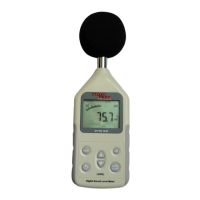
The device features an LCD display that shows the level range, instantaneous sound pressure level, measured value, measurement unit (dB), frequency weighting (A/C), level range bar graph, and indicators for over/under range, slow/fast time weighting, and low battery.

Controls and Indicators:

  • Electric Condenser Microphone: The primary sensor for sound.
  • LCD Display: Shows all measurement data and status indicators.
  • Power Switch: To turn the device on/off.
  • Level Range Control Switch: Allows selection of different measurement ranges (30-80 dB, 50-100 dB, 60-110 dB, 80-130 dB).
  • Maximum Value Hold Switch (MAX): Activates the maximum hold function.
  • Frequency Weighting Select Switch: Toggles between A-weighting (for general sound level measurements) and C-weighting (for checking low-frequency content of noise).
  • Time Weighting Select Switch: Toggles between Fast (for normal measurements) and Slow (for checking average level of fluctuating noise).
  • AC Output Terminal: For connecting to external recording/analysis equipment.
  • DC Output Terminal: For connecting to external recording/analysis equipment.
  • Calibration Control: A potentiometer located inside the battery compartment for calibration.
  • External DC 9V Power Supply Terminal: For external power input.
  • Battery Door: For accessing the battery compartment.
  • Tripod Mounting Screw: For mounting the device on a tripod.
  • Windscreen: To be fitted over the microphone to avoid undesired signals in windy conditions.

Operation Steps:

  1. Power On: Turn on the device.
  2. Select Response and Weighting: Choose the desired time response (Fast/Slow) and frequency weighting (A/C). For general noise sound levels, dBA is recommended. For short bursts of sound, use FAST; for average sound levels, use SLOW.
  3. Select Range: Choose the appropriate level range.
  4. MAX Mode: If selected, the instrument will capture and hold the maximum noise level.

Maintenance Features:

  • Battery Replacement: The device uses one 9V alkaline battery. A low battery mark (a symbol) will appear on the LCD when the battery voltage drops, indicating the need for replacement.
  • External Power: An external DC 9V adapter can be used by inserting the 3.5mm plug into the DC 9V connector on the side panel.
  • Calibration: The device can be calibrated using a standard acoustic calibrator.
    1. Set the device to SPL (dBA) Time, FAST weighting, and an appropriate level range (60-110 dB or 80-130 dB depending on the calibrator type). Ensure MAX function is disabled.
    2. Carefully insert the microphone into the 1/2 inch hole of the calibrator.
    3. Turn on the calibrator and adjust the potentiometer inside the battery compartment until the display indicates the desired level (e.g., 94.0).
  • Recommended Recalibration Period: 1 year.
  • Storage: If not in use for an extended period, remove the battery.
  • Environmental Considerations: Avoid operating the unit in environments with high temperature and humidity. Use the windscreen in windy conditions to prevent undesired signals.

AutoTest Digital Sound Level Meter Specifications

General IconGeneral
BrandAutoTest
ModelDigital Sound Level Meter
CategoryMeasuring Instruments
LanguageEnglish