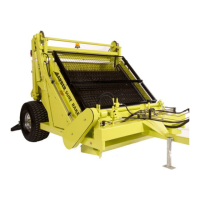
The document provided is an instruction and parts manual for the BARBER SAND MAN Model 850, a machine designed for cleaning sandy areas.
Function Description
The BARBER SAND MAN Model 850 is a specialized machine primarily used for cleaning sandy areas. Its core function involves separating unwanted debris from sand using a vibrating screen. The machine is delivered complete and ready to operate, requiring only the addition of fuel.
Important Technical Specifications
Dimensions and Weight (Packed):
- On a wooden pallet (Fig. 1):
- Length (L): 87 inches (220 cm)
- Width (W): 37 inches (95 cm)
- Height (H): 39 inches (100 cm)
- Weight: 694 lbs (315 kg)
- In a wood crate set on a pallet (Fig. 2):
- Length (L): 87 inches (220 cm)
- Width (W): 37 inches (95 cm)
- Height (H): 39 inches (100 cm)
- Weight: 772 lbs (350 kg)
Major Sections:
The machine comprises four major sections:
- Engine
- Gearbox unit
- Control unit
- Vibrating unit
Gearbox Oil:
- Type: SAE 40 transmission fluid
- Volume: 70 oz
Tire Pressure:
Sieve Sizes (available as replacement parts):
- XXS Small Sieve Assy. (85-10120-3)
- XS Small Sieve Assy. (85-10120-5)
- S Small Sieve Assy. (85-10120-8)
- M Medium Sieve Assy. (85-10120-12)
- Large Sieve. Assy. (85-10120-20)
Usage Features
Packing, Handling, and Transport:
The machine is packed on a wooden pallet, secured with plastic, or in a wooden crate on a pallet. It can be lifted using a forklift or by two rings located on the top center of the frame (Fig. 3). When packed in a wooden crate, the handlebars need to be fitted upon arrival by removing two screws at the top center of the machine, pulling the handlebars back, connecting the hand wheel and arm, and securing them with a snap pin, washer, and locking nut.
Safety Information:
- Only trained operators (at least 18 years old) who have read the manual should operate the machine.
- A visual inspection for damaged or missing parts, guards, or unusual noise/vibration is required before each operation.
- Bystanders must be kept clear (at least ten feet/three meters).
- Large obstacles should be manually removed after stopping and turning off the machine.
- Never attempt to clear jams with the engine running; a jammed shaker component can move unexpectedly.
- OSHA regulations for fire safety, guarding, and lock-out/tag-out procedures must be followed.
- Before any repair or maintenance, the engine must be OFF, in neutral, cooled, and all power sources locked in the "OFF" position and tagged.
- Never allow one person to operate controls while another is near pinch points or machinery with guards removed.
- Avoid operating on steep inclines, extremely irregular, or unstable surfaces to prevent capsizing.
- Modifications require prior written approval from the manufacturer.
- Only manufacturer-supplied or approved replacement parts should be used.
- Operators must wear working shoes and gloves.
Safety Devices:
The kill switch (18) must be steadily engaged during operation. All safety shielding must be in place.
Before Operating:
- Check oil levels in all machine parts and the engine.
- Ensure gearshift lever (1), reversing gear lever (3), and powergear lever (2) are in neutral.
- Clutch lever (11) should be pulled and locked by hook (24).
- Safety lever (18) should be lowered and locked by the clutch lever.
- Start the engine according to the owner's manual.
- Set the engine to slow running (lever 10).
- Pull the clutch lever (11) with the left hand.
- Select direction (FORWARD/REVERSE) using the reversing gear lever (3).
- Engage the desired gear with the gearshift lever (1).
- Slowly release the clutch lever (11) while engaging the accelerator lever (10) to reach the desired speed.
- The differential lock (lever 7) should only be engaged if wheel slippage occurs.
Stopping the Machine:
- Set the engine to slow running (lever 10).
- Release the safety lever (18).
- Close the engine fuel cock.
- Lower the plow-share blade using the depth control wheel (9).
- Reduce the throttle lever (10).
- Release the safety lever (18).
- Close the engine fuel cock.
The operator should never leave the machine unattended; always stop it using these instructions.
Depth Adjustment:
To lower the cutting edge, turn the depth-control wheel (9) clockwise. To lift it, turn the wheel (9) counterclockwise.
Sieve Operation:
- Pull the clutch lever (11).
- Engage the power lever (2).
- Release clutch and gradually lower the cutting edge using the depth-control wheel (9) to maintain sand loading on the screen.
To adjust the swinging frequency of the screen, use the throttle lever (10), ensuring waste material falls into the collection box. If sand is not sifting through and reaches the hopper, pull the clutch lever (11) to stop forward motion and allow the screen to process excess sand. Reduce cleaning depth by turning the depth control wheel (9) counterclockwise.
Change of Direction:
- Pull brake lever (4) for left-hand direction.
- Pull brake lever (5) for right-hand direction.
- For a "U" turn, lift the cutting edge using the depth control wheel (9) or by leaning on the machine to lift the front end before pulling brake levers (4) or (5).
Emptying the Collection Box:
- Stop the machine.
- Set the engine to slow running (lever 10).
- Pull and block the clutch lever (11) with hook (24).
- Block the safety lever (18) with the clutch lever (11).
- Disengage the gearshift lever (1) and power lever (2).
- Lift the plow share.
- Disengage lever (19) by lifting it up.
- Remove container (20) laterally using handle (21).
- Empty the container.
- Reposition the container by laying the gear guide onto the raceway (tilt slightly for easier introduction).
- Engage lever (19) to lock the unit.
Changing Sieve:
This operation must be performed with the machine stopped, cutting edge lifted, and engine off.
- Unscrew the four bolts (22).
- Remove the old screen.
- Install the new screen.
- Replace bolts and tighten securely.
When changing the screen, ensure the short net shoulder is on the blade side (Fig. 7).
Accessories:
The machine can be supplied with a front SCRAPER and its counterweight.
To couple the scraper:
- Unscrew the four bolts (12) from the front-roller support (14).
- Align holes in scraper (13) with the frame.
- Insert bolts and tighten securely.
- Place the counterweight (15) on the rear bar (16).
Working depth adjustment for the scraper is done via wheel (9 – Fig. 5).
Maintenance Features
All maintenance operations must be carried out with the machine stopped, the plow-share lifted, and the engine off.
Clutch:
It is crucial to adjust the clutch cable correctly. If too loose, the clutch will not disengage. If too tight, it will slip, causing premature wear.
Gear Box Service:
- Change oil after the first 100 hours of service.
- Change oil every 300 hours thereafter.
- Use SAE 40 transmission fluid.
- Volume: 70 oz.
- Oil drain plug is indicated as (32) in Fig. 10.
Belt and Pulleys Unit:
- To inspect, replace, or tighten the drive belt, remove the upper cover (27) (Fig. 11).
- Remove protective shield (30). Loosen bolt (29) and adjust pulley arm (28) by HAND, tightening it. Do not overtighten, as this belt must slip if the drive is overloaded (Fig. 12).
- If the unit has an automatic belt tensioner, replace the belt if it is loose beyond the tensioner's ability.
Engine and Air-Filter:
Follow the instructions in the owner's manual provided by the engine manufacturer.
Maintenance Schedule:
Regular Service Period (Engine Oil):
- Check Level: Each Use
- Change: Every 50 Hrs. or 3 Month
Air Cleaner:
- Check: Each Use
- Clean: Every 100 Hrs. or 6 Month (or Every 2 Years if applicable)
- Replace: Every 2 Years (2)
Sediment Cup:
- Clean: Every 100 Hrs. or 6 Month
Spark Plug:
- Check-Clean: Every 100 Hrs. or 6 Month
- Replace: Every 300 Hrs. or Every Year
Valve Clearance:
- Check-Adjust: Every 300 Hrs. or Every Year
Fuel Tank and Strainer:
- Clean: Every 300 Hrs. or Every Year
Fuel Line:
- Check (Replace if necessary): Every 2 Years (2)
(1) Service more frequently when used in dusty areas.
(2) These items should be serviced by an authorized Honda dealer, unless the owner has the proper tools and is mechanically proficient.
SAND MAN Maintenance Schedule:
Transmission fluid (Pg. 11):
- Check Level: Every 3 Month or 100 Hrs.
- Change: After First 100 Hrs., then Every 3 Month or 100 Hrs., and Every Year or 300 Hrs.
Belt tension (Pg. 12):
- Check-Adjust: First Month or 20 Hrs., then Every 3 Month or 100 Hrs.
Belt Tension idler bearing (Pg. C-02 - #18):
- Replace (if necessary): Every 3 Month or 100 Hrs.
Tire pressure (7 PSI):
- Check (Replace if necessary): Each Use
Brake cable tension:
- Check Tension -Adjust: Every 3 Month or 100 Hrs., and Every Year or 300 Hrs.
Throttle Cable:
- Check Tension -Adjust: Every 3 Month or 100 Hrs., and Every Year or 300 Hrs.
Differential Lock Clutch Cable:
- Lubricate: Every 3 Month or 100 Hrs.
Brake Shoes (Pg B-02 - #11):
- Check (Replace if necessary): Every 3 Month or 100 Hrs.
Front roller bushings (Pg. D-01 - #3):
- Check (Replace if necessary): First Month or 20 Hrs.
Sieve bushings (Pg. C-02 - #5, #6, #7):
- Check (Replace if necessary): First Month or 20 Hrs.
- Oil: First Month or 20 Hrs.
Sieve bushings (Pg. C-02 - #6):
- Oil: First Month or 20 Hrs.
Shaker bearings (Pg. C-02 - #10):
- Grease: First Month or 20 Hrs.

 Need help?
 General

 To Next Page