3
by nding his own sense of balance.
4. Whilst holding their hands, encourage the child to kick their
legs and to let go of your hands, one at a time. When your
child is ready, they will discover that it is quite safe to leave
your side and to move freely around the pool.
5. Once your child is swimming condently, begin to remove
one or two oats at a time (evenly to maintain balance),
allowing them to become used to the reduced level
of buoyancy before removing any more.
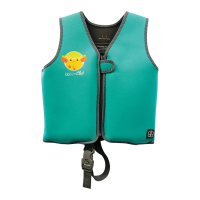
6. Please remember that the Näj is not life jacket.
Children must always be supervised, whilst in or near
the water, by a responsible adult swimmer.
7. Once the last set of oats is removed and your child swims
unaided for the rst time, you should both feel a sense
of accomplishment.
8. Professional swimming lessons should be considered
to develop strength and technique.
Some further advice to help you get the most out of your Näj:
• When transitioning from inatable arm bands or seats,
it is important to allow the child time to adjust to the new
sense of balance of the Näj swim vest.
• Some children take longer than others to become
condent in the water. It is well worth persisting
with a nervous child, as the ultimate freedom allowed
by the Näj will provide your child with much more enjoyment.
• It is essential that you use the proper amount of oats.
Wearing too many oats or not enough oats is unsafe.


 To Next Page