Need help?
Do you have a question about the Becker 1480 and is the answer not in the manual?
Explains how to turn the stereo system on/off and operate it with the ignition switch.
Details manual adjustment of sound level via the volume bar.
Describes automatic volume adjustment based on vehicle speed.
Explains bass and treble control buttons and bar graph indicator.
Details left-to-right stereo balance adjustment using control buttons.
Explains fader control for front/rear speaker balance on equipped models.
Describes the automatic antenna control switch and its positions.
Details using the SEEK and SCAN bars to find stations.
Explains how to choose between low and high tuning sensitivity levels.
Describes tuning directly to a specific frequency using numbered buttons.
Explains using arrow buttons for fine-tuning radio frequencies.
Details storing and recalling favorite stations using memory buttons.
Explains selecting equalization for CrO2 or metal cassette tapes.
Describes how to remove a cassette and switch back to radio.
Details advancing to the next selection or fast forwarding the tape.
Explains repeating a selection or rewinding the tape.
Describes switching to the tape's other side without removing it.
Explains using Dolby B/C noise reduction for reduced hiss.
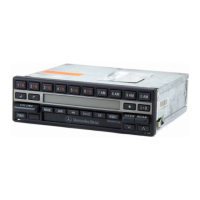
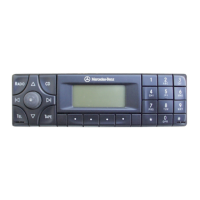
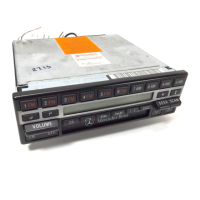
The Becker 1480 is a sophisticated car stereo system designed to provide a comprehensive audio experience, integrating radio and cassette playback with advanced control and display features.
The system's power is managed by an on-off switch located at the lower left corner of the radio faceplate. It operates with the car's ignition switch in either the "on" or "off" position. A unique feature allows cassette playback to begin automatically upon insertion, even without manually turning on the unit.
Volume adjustment is handled by a volume bar on the left side of the faceplate. Pressing upward increases volume, while pressing downward decreases it. A notable feature is the speed-dependent volume adjustment, which automatically modifies the radio and cassette player volume based on vehicle speed. This compensates for increased wind and road noise at higher speeds and lowers volume when returning to local driving, ensuring consistent sound levels.
Tone control is managed by two buttons, marked with musical notes, located above the volume bar. The left button controls bass, and the right controls treble. A bar graph on the left of the display visually indicates the current bass and treble settings. To reset both tones to their midrange settings, both buttons are pressed simultaneously. For maximum bass or treble, the respective button is pressed and held for approximately three seconds until the graph indicates maximum level. Releasing and pressing the button again will drive the tone to minimum in about five seconds. The system remembers separate tone settings for AM, FM, and cassette modes.
Balance control, for left-to-right stereo distribution, uses the same bass and treble buttons. First, the function control button (marked with a star on the right side of the display) is pressed. Then, pressing the bass control shifts sound to the left speakers, and pressing the treble control shifts it to the right. Simultaneous pressing of both buttons sets the balance to the mid-position, with a visual indication on the display when activated.
For models equipped with both front and rear speakers, a fader control is provided on the lower console near the gear selector. Moving the thumbwheel forward increases front speaker output while reducing rear output, and vice versa. Centering the thumbwheel equalizes sound levels.
The automatic antenna is controlled by a three-position rocker switch above the radio. For optimal reception, it should typically be set to its maximum position, allowing the antenna to fully extend.
The radio supports both monaural AM and monaural/stereo FM broadcasts, with a "STEREO" indicator appearing on the display when a stereo signal is received. Waveband selection (AM or FM) is made by pressing any of the numbered station select buttons (1-6 for FM, 7-0 for AM) along the top of the faceplate.
Several methods are available for tuning to specific stations:
Seek and Scan Tuning: The "SEEK" bar on the right side of the faceplate allows scanning broadcast frequencies within AM or FM wavebands. Pressing up scans in ascending frequencies, while pressing down scans in descending frequencies. The "SCAN" bar, located next to the "SEEK" bar, samples radio stations for approximately five seconds each. If no action is taken, the radio tunes to the next station. Pressing either the "SEEK" or "SCAN" bar a second time stops the scan and keeps the radio tuned to the sampled station.
Sensitivity Control: This feature offers two tuning sensitivity levels: low and high, selected by the sensitivity control button on the far right. A single- or triple-ringed symbol on the right side of the display indicates the selected level. In low sensitivity, only the strongest signals are sought, while in high sensitivity, less powerful signals are also included. If no station is found after sampling the entire waveband, sensitivity automatically increases.
Direct Frequency Tuning: To tune directly, first select the desired waveband (AM or FM). Then, press the function control button (star-marked on the right of the display), which clears the display. Next, enter the desired frequency using the numbered buttons (e.g., 9,8,5 for 98.5). The display will show the entered frequency, and the station will begin playing. This method is not recommended while the vehicle is in motion.
Fine Adjustment: The radio can be fine-tuned in small increments using two arrow-marked buttons on the lower right of the faceplate.
Push-Button Memory Tuning: This is the most common method for storing favorite stations. Six FM and four AM stations can be stored using the numbered station select buttons. To store a station, first tune to it using any of the other methods. Then, press and hold the desired numbered station select button until the display shows the new frequency, indicating it has been stored.
To play a cassette, it is inserted into the cassette port, tape side first. The cassette is automatically drawn into the deck. An auto-reverse mechanism automatically plays the other side of the tape at the conclusion of the first side.
Cassette functions are located directly above the cassette port, from left to right:
Tape Switch ("CR"): This feature selects the proper equalization setting for chromium dioxide (CrO2) or "metal" cassette tapes. An LED on the button illuminates when this option is active.
Eject: To remove a cassette, the eject button is pushed. The tape automatically disengages and can be retrieved. Ejecting a cassette switches the system back to radio operation.
Forward Music Search/Fast Forward: Pressing the forward button once automatically advances the tape to the next selection, indicated by an illuminating LED. Pressing the button twice fast forwards the tape to the end of the side, indicated by a blinking LED.
Reverse Music Search/Rewind: Pressing the reverse button once repeats the current cassette selection, indicated by an illuminating LED. Pressing the button twice rewinds the tape completely, indicated by a blinking LED. It locks into position until fully rewound or another tape function is activated.
Track Selection: Once a cassette is engaged, this button switches to the tape's other side without requiring manual removal and flipping.
Dolby® B and Dolby® C Noise Reduction: This function, activated by pressing the Dolby noise reduction button, reduces background hiss when playing cassettes recorded with Dolby B® or Dolby® C noise reduction systems. Most prerecorded cassettes indicate the type of noise reduction used. LEDs on the control button illuminate to indicate the selected noise reduction system.
The display panel provides visual feedback on various system states:
 General
| Brand | Becker |
|---|---|
| Model | 1480 |
| Category | Car Receiver |
| Language | English |

 To Next Page