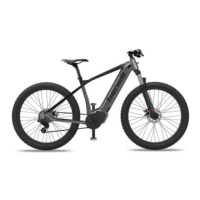
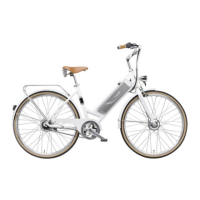
Bicycles are designed in accordance with ergonomics and with proper size, which can not only reduce injuries but also
increase comfort.
It is normally measured as follows:
Ride on the cycle and put your feet on the ground; keep 2.5cm from the crotch to the top tube and 5cm to the
allrounder. For women’s cycles, the joint between the top tube and the head tube shall be kept 2.5cm from the crotch.
2. Riding skill and safety
Correct riding posture ensures safety: the riding posture is dependent on the relative position of the contact between
the rider and the cycle (handlebar, saddle and pedals). It is also closely related to the height of the rider. The riding
posture is important for determining the efficiency of muscle exercise and also the safety of operating handlebar and
brakes.
Follow these riding skills for safety:
⑴Adjust the height of the saddle: step the pedals downwards with heels; the joint and muscle of the lower limbs shall
flexibly bend and stretch, and meanwhile the feet can be slightly straight.
⑵Forward and backward: step on the pedals at the angle of 45 degree and then adjust the saddle forward or
backward until it can match with the hamstring strength at the pedals to be at the best position.
⑶Adjust the position of the handlebar: generally, the upturned grip shall be nearly 30-50mm higher than the saddle,
and the flat handle shall be as high as the saddle. The downturn grip shall keep its top as high as the saddle. After
adjustment, pay attention to the handlebar direction and then lock it.
⑷Correct riding posture: keep your upper body slightly forward and elbows bent as equilateral triangle.
⑸Sitting posture: it is similar to riding a horse; distribute your body weight to the handlebar and pedals; do not put all
your weight on the saddle as it causes hurt to hips.
⑹Pedaling skill: put the front 1/3 point of the shoes at the center of the pedals. Your feet movement shall be parallel
with the central line of the cycle. If not, the efficiency of pedaling will be reduced. Keep even speed, otherwise you
may feel tired. Specially note pulling function which pulls the pedals.
3. Speed change skill:
⑴Do not pedal the cycle reversely when changing speed to avoid chain dropping caused by malfunction.
⑵Do not change the variable gear ratio dramatically; gradually change speed upon terrain to avoid feet fatigue.
⑶When you are 60 meters from the slope, gradually change your speed upon slope. Normally, people are used to
change speed when it is hard to climb, which affects speed, causes danger of falling down and also increases abrasion
of components.
⑷For long-term storage, change the chain to the minimum crankset and the small flywheel to avoid elastic fatigue of
components.
4. Braking skill: the most important for safe driving
⑴Emergency brake skill: for emergency brake, rear brake shall be before front brake. However, people normally brake
both at emergency. If the braking distance is proper, it can brake safely; but if deceleration is too fast, the rider may be
cast forward. To avoid such danger, it is best to brake intermittently and meanwhile push your hips backwards,
especially in rainy days or on boracite roads.
⑵Speed control skill: especially when you ride downhill as it speeds up and prepare for speed change, you must
control brake to decelerate before change in order to prevent danger of exceeding the yellow line and being off the
road.


 To Next Page
 Loading...