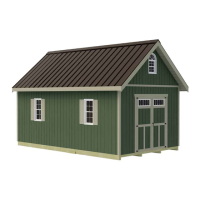
This document serves as an assembly manual for a "Cypress" shed kit, manufactured by Reynolds Building Systems, Inc. It provides detailed, step-by-step instructions for constructing the shed, from laying the foundation to installing the doors and roof. The manual is designed for a do-it-yourself builder, emphasizing clarity and ease of understanding for each stage of the assembly process.
Function Description
The primary function of this device (the shed kit) is to enable individuals to construct a standalone storage building, referred to as a "barn" or "shed." This structure is intended for outdoor use, providing shelter and storage space for various items such as tools, gardening equipment, or other household goods. The kit includes all necessary framing lumber, siding, hardware, and pre-built components, simplifying the construction process for the end-user. The manual guides the user through the entire assembly, ensuring a structurally sound and functional shed upon completion.
Usage Features
The shed kit is designed with several usage features that make it accessible and manageable for DIY builders:
- Comprehensive Step-by-Step Instructions: The manual breaks down the complex process of shed construction into manageable steps, each accompanied by clear diagrams and textual explanations. This modular approach allows users to progress through the build systematically.
- Detailed Material Identification: The manual includes a packing list that meticulously details all included materials, categorized by "2x4 Framing," "White Pine Trim," "Hardware," "Pre-built Components," and "Miscellaneous." This helps users identify and organize parts before and during assembly. It also lists materials supplied by a local home center, such as siding, roof sheathing, and additional plates, ensuring users know what to procure separately.
- Shed Size Versatility: The instructions cater to different shed lengths (8', 10', 12', and 16'), providing specific measurements and material quantities for each size where applicable. This flexibility allows users to choose a shed size that best fits their needs and space.
- Floor System Options: The manual describes construction details for a "Deluxe Floor System," which includes 4x4 treated runners. It also mentions that standard floors do not include these runners, implying flexibility in foundation choice. For concrete slabs, it advises installing sill sealer as a moisture barrier, indicating adaptability to various site conditions.
- Siding Application Guidance: Specific instructions are provided for applying siding, including how to identify the "LAP" or "Tongue Edge" for proper installation. It also details how to square walls before applying siding and the correct nailing techniques (8d galv. nails, 12" apart).
- Gable and Truss Assembly: The manual guides users through assembling roof trusses and gables, including how to secure rafter halves with wood gussets and install collar ties. It also provides methods for temporarily supporting components during assembly, such as using 2x4 blocks, to aid in stability and alignment.
- Door Installation Flexibility: The manual offers two options for door placement: "Offset Doors" (Step 6) and "Doors Centered" (Step 7), allowing users to choose the layout that best suits their functional requirements. It also provides detailed instructions for cutting siding around door openings and installing door jacks and headers.
- Optional Window Integration: For those installing an optional window, the manual provides specific cutting dimensions (18-3/8" x 27-1/4" opening, 36" from the bottom of the siding), although it notes that for a 12' long building, there might not be enough space for wood shutters.
- Roof Sheathing and Overhang Installation: Instructions cover installing 2x3 overhangs and 1x4 fascia, emphasizing alignment with the trusses using a straight edge. It also details how to cut and install roof sheathing, including the use of plyclips and maintaining a 1" space from the roof peak for proper ventilation.
- Trim Installation: The manual provides guidance for installing various trim pieces, including gable trim, corner trim, and door trim, ensuring a finished appearance and structural integrity.
- Hardware Integration: Specific hardware, such as 10d sinkers, 8d galv. nails, 7d sinkers, 6d common nails, 5" door hinges, 6" barrel bolts, door latch, hinge screws, and 1" screws, are listed and their application explained throughout the assembly steps. The manual even specifies the type of bit needed for the square-head screws.
- Safety Recommendations: A crucial usage feature is the explicit safety warning: "Always wear safety glasses when cutting or nailing!" This highlights the manufacturer's commitment to user safety during the construction process.
- Customer Support: The manual provides contact information (phone numbers and email) for assistance with assembly questions, including after-hours support, ensuring users have access to help if needed.
- Pre-Construction Checklist: It advises users to study the manual, obtain a building permit, and check local building code regulations before starting construction, promoting responsible and compliant building practices.
- Material Management Tips: The manual suggests unpacking and stacking boards by size and advises against discarding any material until the building is complete, aiding in efficient material management. It also notes that some boards have colored ends, which might be a further aid in identification.
Maintenance Features
While the manual primarily focuses on assembly, it includes several implicit and explicit maintenance-related features and recommendations to ensure the longevity and durability of the shed:
- Treated Lumber for Floor System: The "Deluxe Floor System" utilizes 4x4 treated runners, indicating a design choice aimed at resisting moisture and decay, particularly important for components in contact with the ground.
- Primed Siding: The siding provided in the kit is primed, but the manual explicitly states, "You will need to apply a finish coat using latex acrylic paint." This is a critical maintenance step to protect the siding from weather elements and enhance its lifespan.
- Sealing Door Edges: For door installation, the manual provides a "Tip" to "Paint the siding and the door frames before you attach the siding to the door." It further advises to "Seal the bottom edges of the siding and door frames. If the bottom of the doors are in close vicinity to the ground or ramp, they will absorbed moisture and rot." This is a direct instruction for preventative maintenance against moisture damage.
- Allowances for Wood Expansion: During door installation, the manual instructs users to "Leave a space at the top of the doors and between the doors and the side trim to allow room for the doors to expand when they absorb moisture." This design consideration and instruction help prevent binding and damage to the doors and frame due to natural wood movement.
- Roof Ventilation: The manual mentions that "Ridge vent provides ideal ventilation, preventing heat or moisture from damaging your building or its contents." This highlights a built-in feature designed to mitigate internal moisture buildup, which is crucial for preserving the shed's structure and its contents. The instruction to leave a 1" space from the top of the roof sheathing and roof peak during installation further supports this ventilation design.
- Shingle Installation (Optional): For optional shingles, the manual advises installing "metal roof edge the perimeter of the building" and installing shingles "according to the instructions on the wrapper." It also suggests consulting "good publications at book stores or newsstands" for more detailed instructions. Proper shingle installation is a key maintenance aspect for roof integrity and weather protection.
- Reimbursement for Lumber Replacement: The manual states, "Our framing lumber is imported to provide you the highest quality available. However, if you need to replace any lumber for any reason please do so and we will reimburse you." While not a direct maintenance feature, this policy implies a commitment to quality and supports the long-term integrity of the structure by ensuring sound materials.
- Floor Leveling and Squaring: The importance of a level and square floor is repeatedly emphasized, with instructions on how to achieve this by measuring diagonals and toenailing the frame to the runners. A properly constructed foundation is fundamental to the overall stability and longevity of the shed, reducing future structural issues.
In summary, the Cypress shed kit and its accompanying manual are designed to empower individuals to construct a durable and functional storage building, with clear instructions and considerations for both initial assembly and long-term structural health.

 Need help?
 General

 To Next Page