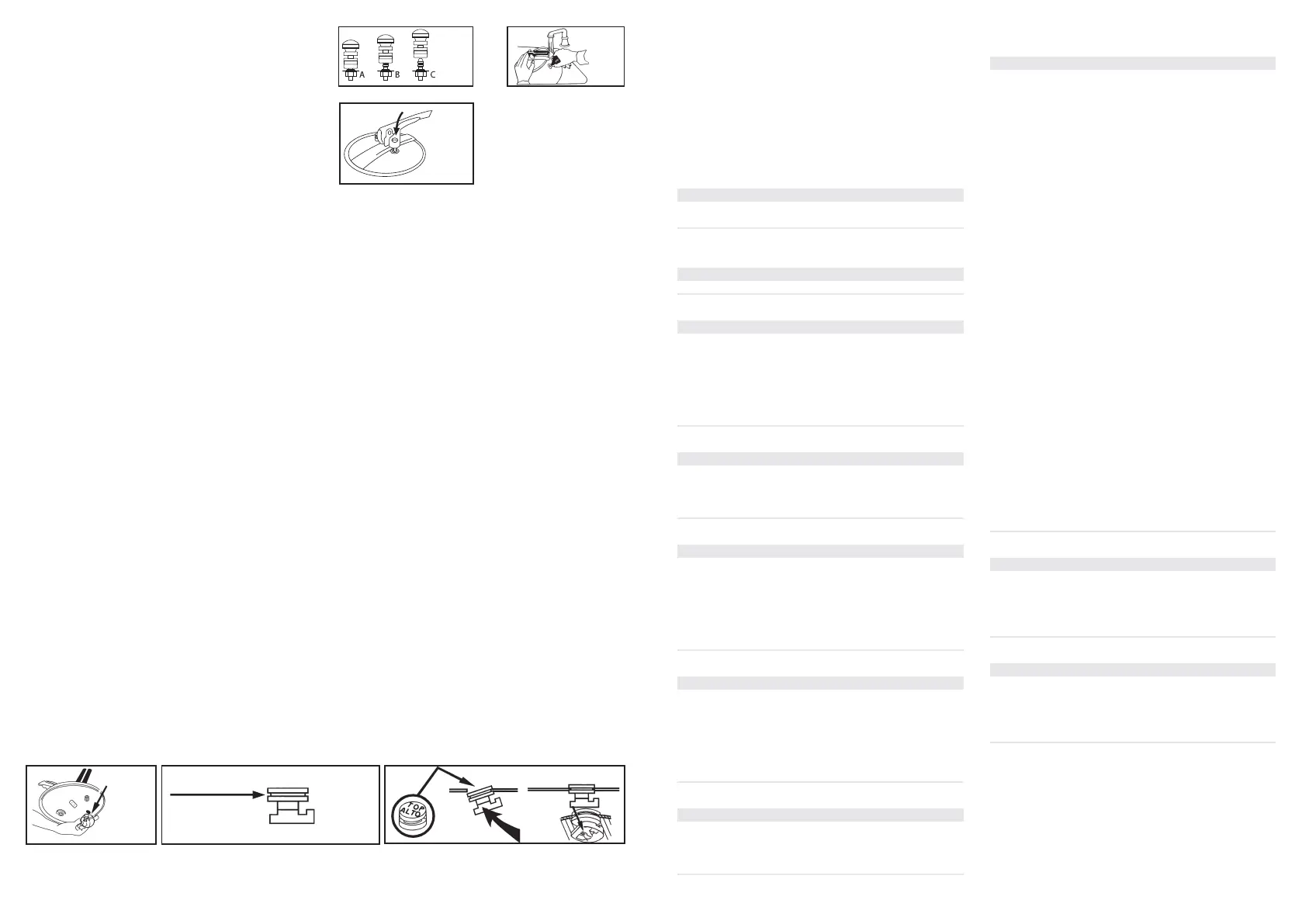
Figure 2 Figure 3
Figure 4
Figure 5
Bottom/Inside
Top/OutsideHollow
Bottom/Inside
Top/Outside
The cooking times are indicative and must be calculated from the initial hiss of the
operating valve.
VEGETABLE SOUP:
From 20 to 45 minutes, depending on the type of vegetable, applying the cooking time
of the vegetable to be cooked longer.
MINESTRONE SOUP:
The same as for the vegetable soup, adding noodles or rice about 5 minutes before the
end of cooking.
Quantity Water Time
MILANESE RISOTTO ½ kg 1 litre 5 min.
POLENTA (corn porridge) (*) ½ kg 1 ½ litres 20 min.
(*) after having stirred the maize in boiling water until it has the desired consistency.
BRAISED MEAT
Quantity Water Time
BEEF 700 g 2 glasses 20-30 min.
BOILED MEAT
Quantity Water Time
VEAL ½ kg 1 litre 30-35 min.
BEEF ½ kg 1 litre 40-45 min.
CHICKEN ½ kg 1 litre 20-25 min.
SPRING CHICKEN ½ kg 1 litre 14-16 min.
BOILED SALAMI ½ kg 1 litre 20-22 min.
VEAL TONGUE 800 g 1 litre 55-60 min.
Cured BEEF TONGUE 1 kg 1 ½ litres 60 min.
STEWED MEAT
Quantity Water Time
CHICKEN ½ kg ½ glass 20-25 min.
LAMB ½ kg ½ glass 20-25 min.
VEAL ½ kg ½ glass 30-35 min.
BEEF ½ kg ½ glass 50 min.
ROASTS
Quantity Water Time
VEAL ½ kg ½ glass 20-25 min.
BEEF ½ kg ½ glass 30-35 min.
CHICKEN ½ kg ½ glass 15 min.
SPRING CHICKEN ½ kg ½ glass 10 min.
PORK ½ kg ½ glass 15 min.
LAMB ½ kg ½ glass 15-20 min.
ROASTBEEF ½ kg ½ glass 25-30 min.
BOILED FISH
Quantity Water Time
SPINY-LOBSTER 1 kg 1 ½ glasses 10 min.
MUSSELS 1 kg 1 ½ glasses 10 min.
SHRIMPS ½ kg 1 ½ glasses 6-8 min.
COD ½ kg 1 generous glass 14-15 min.
PERCH 1 kg 1 ½ glasses 6-8 min.
SCAMPI ½ kg 1 ½ glasses 5 min.
WHOLE TROUT 1 kg 1 ½ glasses 1- 1 ½ min.
DRY LEGUMES (*)
Quantity Water Time
CHICK PEAS ½ kg 3 glasses 40-50 min.
BEANS ½ kg 3 glasses 40-50 min.
BROAD BEANS ½ kg 3 glasses 40-50 min.
LENTILS 300 g 3 glasses 20-30 min.
(*) Soaked in water for 10, 12 hours.
COOKING TIMES
FRESH VEGETABLES
Quantity Water Time
ASPARAGUS STEMS 1 kg 1 ½ glasses 4-5 min.
WHOLE BEETROOTS 1 kg 1 ½ glasses 18-20 min.
CHOPPED BEETROOTS 1 kg 1 glass 15-18 min.
BROCCOLI 1 kg 1 glass 10 min.
CHOPPED ARTICHOKES 1 kg 1 glass 12-14 min.
WHOLE ARTICHOKES 1 kg 1 ½ glasses 12-15 min.
CHOPPED CARROTS 1 kg 1 glass 4-6 min.
WHOLE CARROTS 1 kg 1 ½ glasses 5-6 min.
CHOPPED CAULIFLOWER 1 kg 1 glass 4-5 min.
WHOLE CAULIFLOWER 1 kg 1 ½ glasses 6-8 min.
CABBAGE 1 kg 1 ½ glasses 10-12 min.
CHICORY 1 kg 1 glass 3-4 min.
CHOPPED ONIONS AND SILVER SKIN ONIONS 1 kg 1 glass 5-6 min.
WHOLE ONIONS 1 kg 1 ½ glasses 8-10 min.
CHARDS 1 kg 1 glass 7-8 min.
FRESH BEANS 1 kg 1 ½ glasses 15-20 min.
FRENCH BEANS 1 kg 1 glass 3-4 min.
BROAD BEANS 1 kg 1 glass 5-6 min.
MUSHROOMS 1 kg 1 glass 4-5 min.
EGGPLANTS 1 kg 1 glass 7-8 min.
CHOPPED POTATOES 1 kg 1 glass 5-6 min.
WHOLE POTATOES 1 kg 1 ½ glasses 12-14 min.
NEW POTATOES 1 kg 1 glass 10-12 min.
GREEN PEAS 1 kg 1 glass 2-3 min.
TOMATOES 1 kg ½ glass 2-3 min.
LEEKS 1 kg 1 ½ glasses 5-6 min.
CHOPPED TURNIPS 1 kg 1 glass 12-14 min.
WHOLE TURNIPS 1 kg 1 ½ glasses 14-16 min.
BLACK SALSIFIES 1 kg 1 ½ glasses 7-8 min.
CHOPPED CELERY ½ kg 1 glass 7-8 min.
SPINACH 1 kg ¾ glass 3-4 min.
SAVOY CABBAGE 1 kg 1 glass 4-5 min.
CHOPPED PUMPKIN 1 kg 1 ½ glasses 3-4 min.
SLICED PUMPKIN 1 kg 1 ½ glasses 5-6 min.
ZUCCHINI 1 kg ¾ glass 2-3 min.
FRESH FRUIT
Quantity Water Time
APRICOTS ½ kg 1 glass 2 min.
CHERRIES ½ kg ¾ glass 2 min.
PEACHES ½ kg ½ glass 2 min.
APPLES ½ kg 1 glass 4-5 min.
PEARS ½ kg ½ glass 2-3 min.
DRIED FRUIT (*)
Quantity Water Time
APRICOTS 200 g ½ glass 5-6 min.
CHESTNUTS ½ kg ½ litre 40-45 min.
FIGS 200 g ¾ glass 10-12 min.
PEACHES 200 g ½ glass 5-6 min.
PLUMS 200 g ½ glass 8-10 min.
(*) soaked in water for about 1 hour; chestnuts 4-5 hours
At the end of the cooking time, move the pressure cooker
away from the source of heat and lift the safety valve to its
midway position (see figure 2 - B) in order to discharge the
steam; pour some cold water on the lid to help speed up the
release of pressure (see figure 3).
Before opening the pressure cooker, check that the lever
handle Systemblock
®
locking device has returned to its
original position (low). Never try to force open the lid if the
Systemblock
®
is raised (see figure 4). After this the lid can
be opened without problems.
After using it, always wash the pressure cooker in hot water and washing-up detergent. Rinse and dry it.
Never put the lid in the dishwasher. Simply rinse under running tap water, remove the safety valve (see fi gure 2 - C) and clean the nozzle in the
lid with a needle. Dry immediately. The pressure cooker should be put away with the lid off to avoid unpleasant odours building up.
For total personal safety and so that the pressure cooker lasts longer, we recommend in particular:
- that children do not touch or tamper with the pressure cooker when in use;
- never using it to fry;
- never putting the closed pressure cooker in a hot oven;
- remembering that when in use pressure is built up inside the pressure cooker;
- never touching the overheated metal parts: if necessary, protect your hands as usual;
- never leaving food in the pressure cooker for long periods of time. The salts and acids in food can damage it;
- not using bleach, hydrochloric acid or abrasives that can damage or scratch the steel.
The working pressure of this model of Aeternum Pressure Cooker is between 0.4 and -0.8 bar (circa 106°C÷-115°C).
What to do if
- A few minutes after putting the pressure cooker on the heat, the steam is not discharged by the operating valve and
the Systemblock
®
is raised (see fi gure 1), CHECK THAT:
- the operating valve is working properly, lifting it up (see fi gure 2 - B):
- If steam is discharged from it, everything is normal and you can continue cooking. Otherwise, IMMEDIATELY SWITCH OFF THE HEAT and,
after having cooled down the pressure cooker and discharged the steam, CHECK THAT the nozzle of the valve is not clogged or blocked.
- If no pressure builds up inside the cooker, e.g. the Systemblock
®
is not raised (see fi gure 4), CHECK THAT:
- the lid is closed correctly;
- the gasket of the lid is not worn out or badly positioned (replace it if necessary);
- the safety plug is in the correct position;
- the operating valve and Systemblock
®
are thoroughly screwed on;
- there is enough liquid;
- the source of heat is strong enough.
- If the steam comes out from the edge of the lid:
IMMEDIATELY SWITCH OFF THE HEAT and, after having cooled down the pressure cooker and released the steam, CHECK THAT:
- the lid is closed correctly;
- the gasket of the lid is not worn out or badly positioned (replace it if necessary);
- there is not too much liquid in the pressure cooker.
- If the safety plug is activated:
IMMEDIATELY SWITCH OFF the heat and, after having cooled down the pressure cooker and released any residual pressure, carry out all the
above checks.
- Putting back and/or replacing the safety plug/valve
To put back and/or replace these, insert the plug (into its seat in the lid, working from the inside, fi g. 5) so that TOP-ALTO remains outside the
lid. Make sure that the hollow of the PLUG fi ts perfectly, for the whole of its circumference, into the hole on the lid.
IMPORTANT: In all cases, if the checks suggested do not produce any result and, in any case, in case of doubt and for any other malfunctioning,
please always contact the retailer. The year and manufacturing lot which guarantee the traceability of the product are shown on the pressure
cooker.


 To Next Page
 Loading...