EasyManua.ls Logo

Biddle MEGGER - Page 59

Default Icon
62 pages
Print Icon
To Next Page IconTo Next Page
To Previous Page IconTo Previous Page
Loading...
]
tage
rating
may
be
taken
as
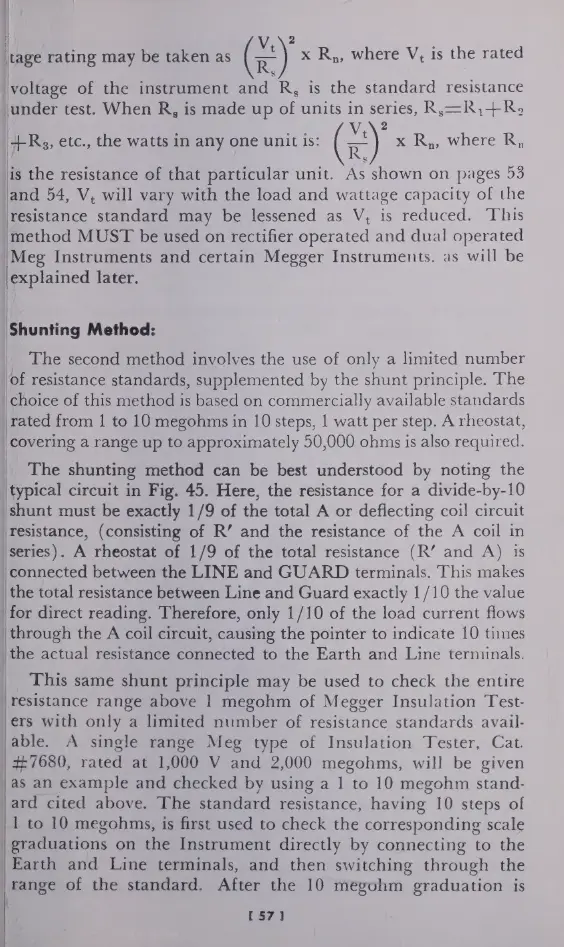
(
s
VANG
$
x
R,,
where
V,
is
the
rated
voltage
of
the
instrument
and
R,
is
the
standard
resistance
under
test.
When
R,
is
made
up
of
units
in
series,
Re=R;+R-2e
;
δον;
VNE
ΕΤ,
etc.,
the
watts
in
any
one
unit
is:
R
©)
x
R,,
where
R,
Ng
is
the
resistance
of
that
particular
unit.
As
shown
on
pages
53
and
54,
V,
will
vary
with
the
load
and
wattage
capacity
of
the
resistance
standard
may
be
lessened
as
V,
is
reduced.
This
method
MUST
be
used
on
rectifier
operated
and
dual
operated
Meg
Instruments
and
certain
Megger
Instruments.
as
will
be
explained
later.
Shunting
Method:
The
second
method
involves
the
use
of
only
a
limited
number
of
resistance
standards,
supplemented
by
the
shunt
principle.
The
choice
of
this
method
is
based
on
commercially
available
standards
rated
from
1
to
10
megohmis
in
10
steps,
1
watt
per
step.
A
rheostat,
covering
a
range
up
to
approximately
50,000
ohms
is
also
required.
The
shunting
method
can
be
best
understood
by
noting
the
‘typical
circuit
in
Fig.
45.
Here,
the
resistance
for
a
divide-by-10
shunt
must
be
exactly
1/9
of
the
total
A
or
deflecting
coil
circuit
resistance,
(consisting
of
R’
and
the
resistance
of
the
A
coil
in
series).
A
rheostat
of
1/9
of
the
total
resistance
(R’
and
A)
is
connected
between
the
LINE
and
GUARD
terminals.
This
makes
the
total
resistance
between
Line
and
Guard
exactly
1/10
the
value
for
direct
reading.
Therefore,
only
1/10
of
the
load
current
flows
through
the
A
coil
circuit,
causing
the
pointer
to
indicate
10
times
the
actual
resistance
connected
to
the
Earth
and
Line
terminals.
This
same
shunt
principle
may
be
used
to
check
the
entire
resistance
range
above
1
megohm
of
Megger
Insulation
Test-
‘ers
with
only
a
limited
προς
of
resistance
standards
avail-
able.
A
single
range
Meg
type
of
Insulation
Tester,
Cat.
|
#7680,
rated
at
1,000
V
and
2,000
megohms,
will
be
given
|as
an
example
and
checked
by
using
a
1
to
10
megohm
stand-
ard
cited
above.
The
standard
resistance,
having
10
steps
of
l
to
10
megohms,
is
first
used
to
check
the
corresponding
scale
|
graduations
on
the
Instrument
directly
by
connecting
to
the
Earth
and
Line
terminals,
and
then
switching
through
the
కం
of
the
standard.
After
the
10
68010
graduation
is
|
[57]
|