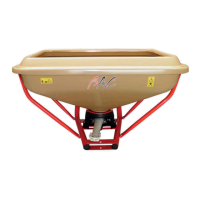
Abonadora Pendular /
Pendulum Spreader
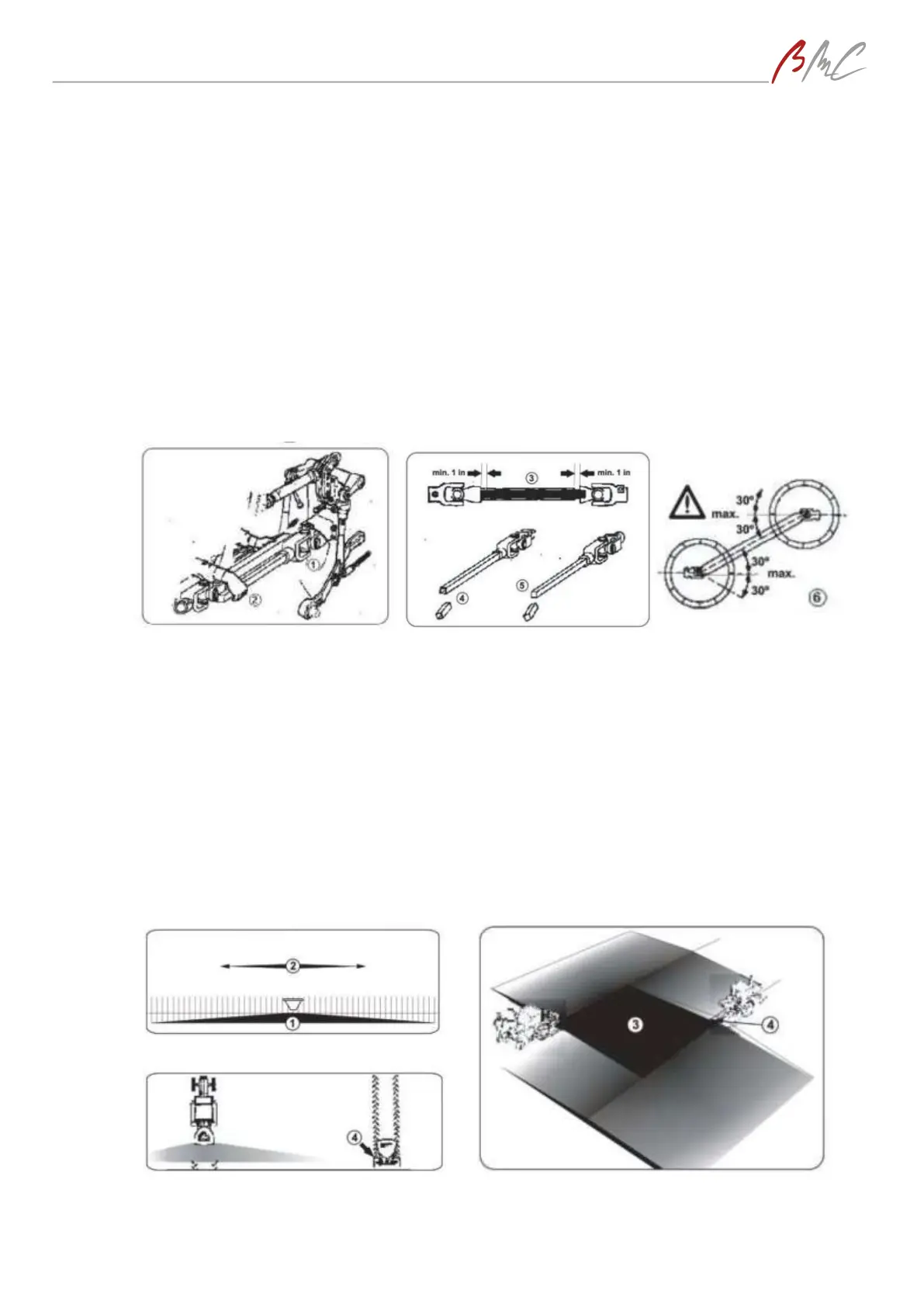
4.2. Conexión de la trasmisión / Pto.Shaft Connection
Eleve la abonadora pendular hasta que la trasmisión alcance la altura del eje de conexión
al tractor (1). Una parte de la trasmisión ha de ser conectada al tractor y la otra parte a
la abonadora. Asegúrese de que ambos tubos están superpuestos entre sí, por lo menos
1 pulgada (2,54 cm) (3). Corte la protección de los tubos a la longitud correcta si la
trasmisión es demasiado larga y a continuación corte el perfil del tubo a la longitud
correcta (4) y (5). Es importante que el ángulo de movimiento de la trasmisión nunca
exceda los 30º.
Lift the Spreader until the PTO shafts reaches the height of the shaft connection of the
tractor (1). Half of the PTO shaft has to be connected to the Spreader and the other half
to the tractor, holding them side by side (2). Be sure that both tubes overlap each other
by at least 1 inch. (3). Cut the guard tubes to the correct length if the shaft is too long
and then cut the profile tubes to the correct length (4) and (5). It is important that the
angle of the moving PTO shaft must never exceed 30º.
4.3. Distribución homogénea / Homogeneus distribution
La manera más eficaz para que la distribución del abono en el campo sea homogénea y
no se produzca una mayor concentración en la parte central es que el tractor haga el
recorrido de vuelta lo más pegado posible a la parte abonada tal y como se muestra en
los dibujos.
When distributing fertilizers or seed a greater concentration of product will be found in
the center and a lighter spread will occur in the edge of the pattern (1) and (2). In even
to obtain a more even spread, you must compensate across the edges of the pattern.
The most effective way is to drive the tractor, on the return trip, as close as possible to
the outer edge of the previous pattern (3) and (4).


 To Next Page
 Loading...