88 Specifications
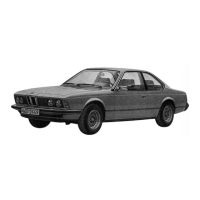
BMW 633 Csi -fuel injection
The L+etronic system on your BMW
measures the volume of air drawn into
the engine. The `L' prefix indicates that
this method of mixture control is used.
From the air cleaner the intake air passes
via an airflow meter and the throttle
butterfly stub pipe into the air collector,
from which an intake pipe [eads to each
cylinder.
Each cylinder is provided with an electro-
magnetic injector ahead of the inlet
valve, in order to ensure the necessary
precision for good engine response and
mi n i mu m exhaust emissions.
An additional air slide bypasses the
throttle butterfly and controls the volume
of additional air which the engine needs
for smooth running when still cold. The
idle air supply is controlled when the
engine is warm by a bypass which also
avoids the throttle butterfly.
1. Fuel supply
An electrically driven roller compartment
pump delivers fuel from the tanl( and
builds up the injection pressure. A filter
is incorporated into the fuel supply line.
The pressure regulator is connected by
hose to the intake pipe. This ensures that
the pressure differential between fuel and
intaike pipe pressures remains constant,
so that the volume of fuel injected de-
pends only on the period of injector
open ing time.
2. Control of fuel volume
The volume of air drawn in by the engine
is measured by the airflow meter and
converted by a potentiometer into a
signal of a given voltage, which is then
transmitted to the control unit. This
divides the signal by the engine speed,
and thus arrives at the correct volume of
fuel. The engine speed input is derived
from the time elapsing between two
successive ignition pulses.
All injectors are wired electrically in
parallel, so that they deliver fuel at the
same time. However, the injection of fuel
takes place at different stages in the
:Pdeer?ti:gencsyuc;:af:rade:#at:¥/jnudn::òrLn
combustion process, half of the calcu-
lated volume of fuel is injected for each
half-turn of the camshaft (equivalent to
each complete turn of the crankshaft).
3. Cold-start and warm-up - automatic
mechanism
When starting at low temperatures, and
during the subsequent warm-up phase,
the engine needs an additional supply of
fuel. lf engine temperature is below a
given value, the cold-starl valve delivers
fuel for as long as the starter is operated
and the heat-sensitive time switch re-
rh%ì:Switc:3Siendtèrfubp°t:etht:!So[3.mstpae[aj:,rveé
electric circuit, so that no fuel is injected.
Puu'r:ngeàhseorwianrTh-:pc.opoh,:ns:.s#ee#p::::
trols mixture enrichment via the control
unit. As engine temperature rises, the
volume of additional fuel gradually de+
creases to zero at normal operating
temperature.
Apart from additional fuel for starting anc
warming up, the engine also requir=
more air for idling. The additional aL
slide ,bypasses the throttle butterfly; àts
aperture cross-section and thus trE
volume of additional air depend cr
coolant temperature. At normal opera:-
inò tempature, the slide is fully closec.
Idle and full-Ioad correction are con-
trolled by two contacts in the throtde
butterfly switch.
4. The electronic control unit
This unit's task is to supply a controi
pulse to the electromagnetic injectors.
•thus determining the length of time they
remain open. It processes informatioTi
received from the engine's sensors.
which convert the engine's operating
condition into electrical values.
5. The airf]ow meter
:thi:svuoptp:òeesàes#à'etnott::?::trao,`riY.n*
volume passing into the engine. The
rectangular baffle is held shut in a
passage of closely identical form by ttìe
actìon of a coil spring, and is forced open
against this spring by the force óf the
incoming airflow. The baffle plate shaft
alters the setting of a potentiometer, so
#ot t:: gàfj,Ì:aR::tt:vsrtgàee jssìà3àyegn#
transmitted to the control unit. The signaJ
output in volts is in inverse proportion to


 To Next Page
 Loading...