For the greasing best use a trade-mark
lubricating grease, which should always be
stored in its well-closed container in order to
prevent the ingress of dust and dirt.
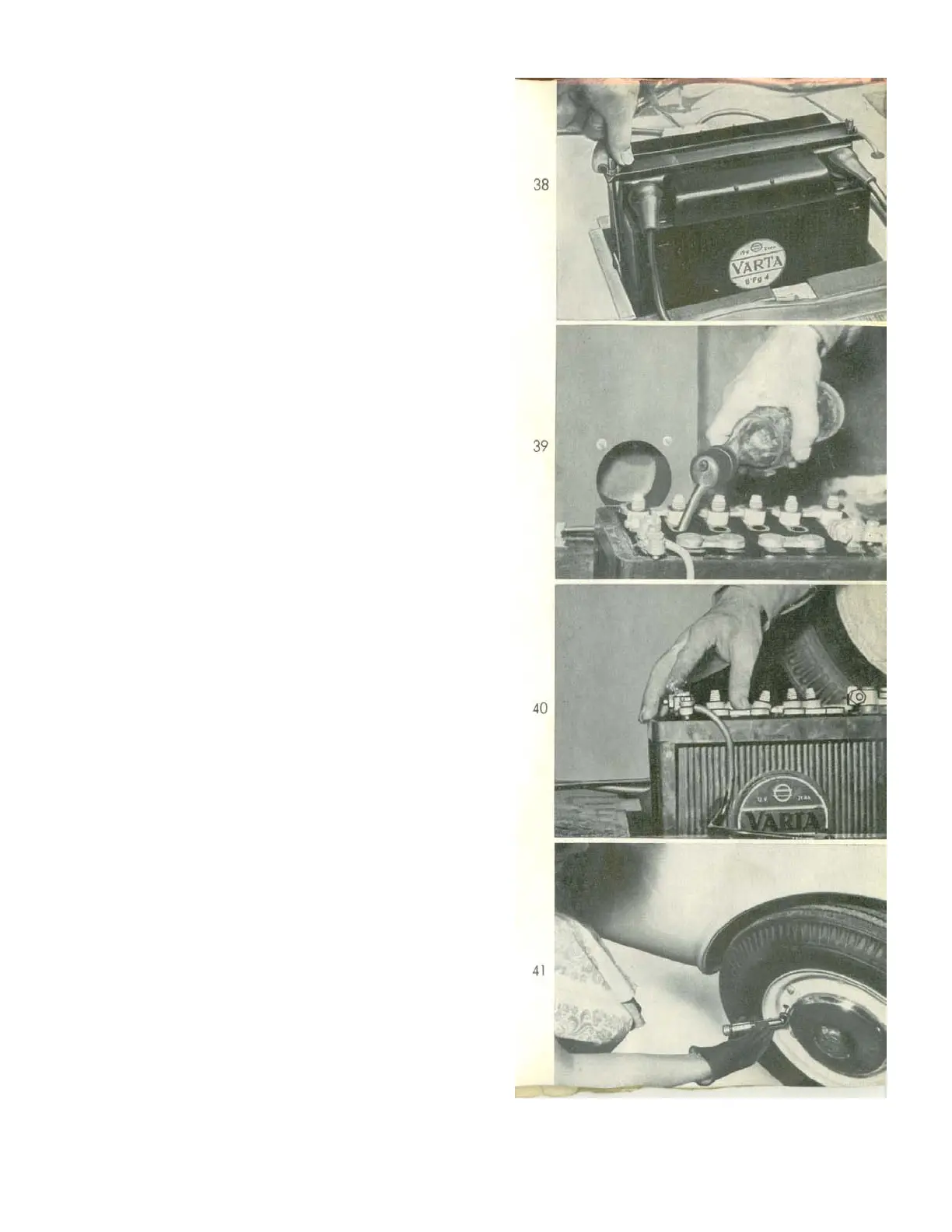
After removal of the seat (see page 16 figure
29) the battery is accessible for checking and
maintenance. The battery cover is removed
by lifting the two cover holding springs, right
and left (figure 38). This gives access to 6
plugs, which are unscrewed to add distilled
water. This check should be performed every
1500 kilometers (about 1000 miles), i.e. every
4 to 6 weeks. The topping-up with distilled
water (never use battery electrolyte) is done
by means of a clean container with a rubber
filler plug, which can be obtained for a few
pennies in an accessory shop, bringing the
level in each cell to approximately 10mm (.4")
above the plates (figure 39). Coat the clean
posts and terminals with light grease or
Vaseline to prevent corrosion (figure 40).
The tire pressures should be checked at
shorter intervals, every 300 miles at least or
once every week. If this is performed with
your own tire gauge (figure 41) test from time
to time with a calibrated tire gauge at a filling
station in order to control the correct
functioning of your own gauge. The tire
pressures should be adjusted to 17lbs./sq. in.
(front) and 14lbs./sq. in. (rear). If one always
rides alone a front tire pressure of 15.6
Ibs./sq. in. will be sufficient. The pressure
difference between the two rear wheels or the
two front wheels
19


 To Next Page