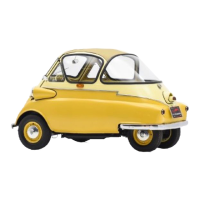
Some more explications
The Isetta engine size has been conceived
for performances allowing the Isetta driver to
easily follow the traffic stream. This means,
however, that he must be given momentary
swift acceleration — to pass other vehicles
for instance — as a definite factor
contributing to the driving safety.
Consequently, the Isetta engine has been
designed to provide relatively high speeds
(up to 53 mph) for short instants, a feature
you will appreciate in many situations.
This quick acceleration, however, is not
intended to induce the Isetta owner to
continually run the engine at its possible
maximum speed. The Isetta motor is of the
high efficiency type. It therefore only depends
on you to run it as reasonably as to obtain a
long service life.
Test rides over many 100,000 miles and
numerous testimonials from lsetta drivers
have proved it an acknowledged fact that with
reasonable motoring the Isetta owner
possesses an engine of proverbial reliability.
Now, what's about reasonable motoring?
First the breaking-in or running-in as Britons
say. Make it a rule to strictly follow the
breaking-in instructions! The care devoted to
your engine will pay you unexpected
dividends during its service life. Thus the
breaking-in of high-performance engines is a
rather important matter.
A transfer picture on the windshield quite in
front of your eyes tells you at a glance how
fast you can run in each gear during the
breaking-in period. Bear this well in mind
when driving uphill and above all when
descending a gradient! And another point:
Don't forget to carry out the oil change in
time.
And now the driving after the breaking-in
period. Once done the running-in you may
thoroughly use the efficiency of your engine
unit. The "resistance point" en-countered by
the accelerator pedal, that is the resistance to
be felt at a certain point when depressing this
pedal indicates you to "what an extent you
can depress the accelerator without having to
glance at the speedometer dial. For a jump to
pass another vehicle you can use the full
acceleration capacity without hesitation, but
don't forget to let the gas pedal return to the
resistance point as soon as you have
achieved the passing Jump: That means the
speedometer pointer must soon leave the
red-colored segment that is entered at the 50
m.p.h.-mark.
You can also somewhat exceed the 50 m.p.h.
mark when driving downhill for short periods.
When ascending a gradient depress the gas
pedal to the resistance point only, -
temporarily you can depress it also to its full
extent for a passing jump for instance or on
hair-pin bends, but thereafter the pedal must
return to the resistance point!
When driving away and accelerating step on
the gas pedal slowly and only to the
resistance point. This may cost you some
tenths of a second, but the engine will reward
it on the long run and besides you'll spare
gasoline for the resistance point is also an
economizing position.
The decalcomania on the windshield, in the
direct line of your vision, shows you the
cruising speeds you should not exceed in the
individual gears. The resistance point gives
you a warning and moreover the speed limits
for the various gears are clearly marked on
the speedometer dial. Thus you cannot fail to
do things well.
5


 To Next Page
 Loading...