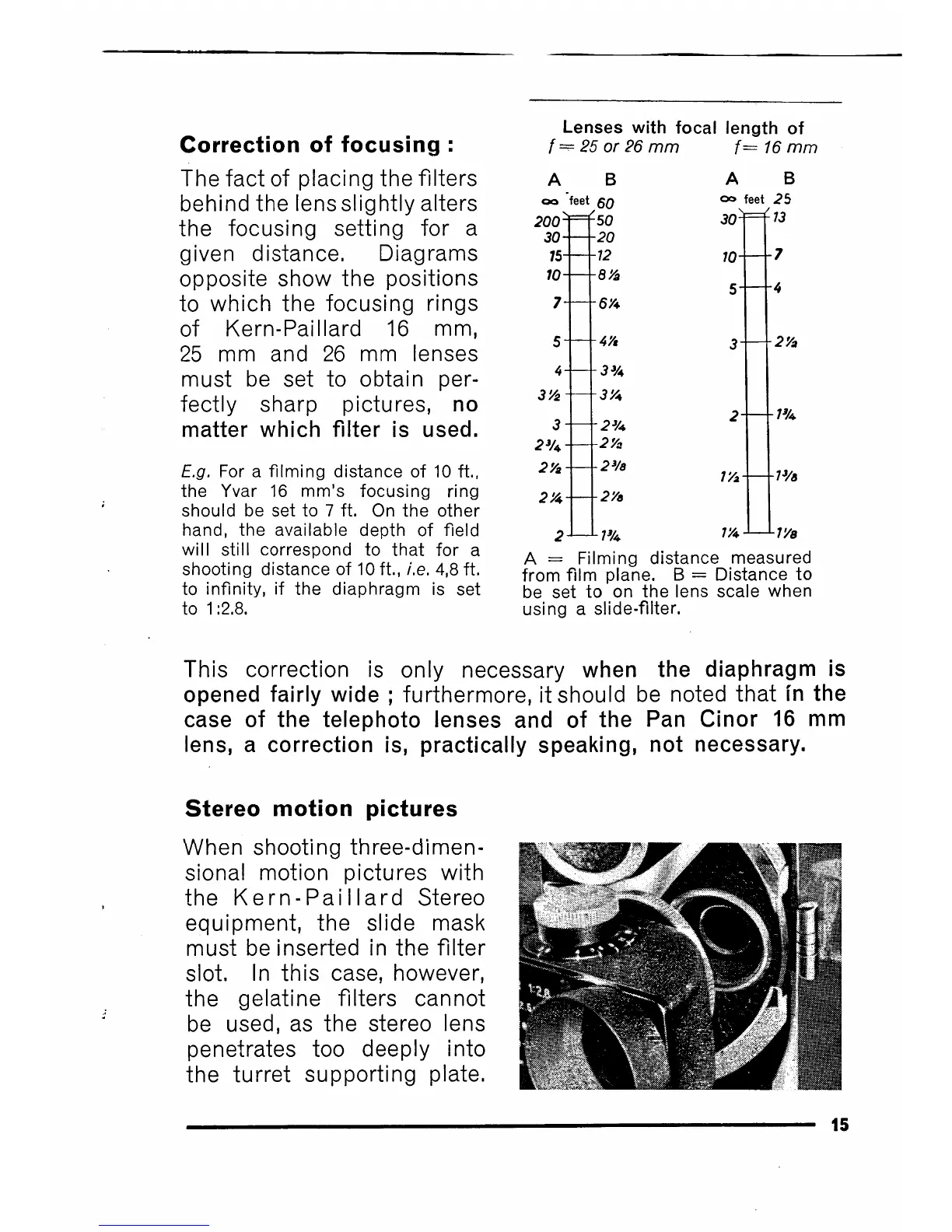
Correction of focusing :
The fact of placing the filters
behind the lensslightly alters
the focusing setting for a
given distance. Diagrams
opposite show the positions
to which the focusing rings
of Kern-Paillard 16 mm,
25 mm and 26 mm lenses
must be set to obtain per-
fectly sharp pictures, no
matter which filter is used.
E.g. For a filming distance of 10 ft.,
the Yvar 16 mm's focusing ring
should be set to 7 ft. On the other
hand, the available depth of field
will still correspond to that for a
shooting distance of 10 ft., i.e. 4,8 ft.
to infinity, if the diaphragm is set
to 1:2.8.
Lenses with focal length of
f =25 or 26 mm f=
16
mm
A B A B
oo
feet
60
oo feet
2 5
200-
-50
30-
=
-13
30- -20
75-
-12
10-
-7
10-
:
8/a
5-
-4
7-
-6/4
5-
-4'/*
3-
-2'A
4-
-3%
3'/2-
3'A
2-
-m
3-
-2
3
A
-m
2
3
A-
-2'A
2y
a
-
-2
3
/a
1 VI-
-P/8
2'A~
-2'/o
2- -m
ta-
-V/B
A = Filming distance measured
from film plane. B = Distance to
be set to on the lens scale when
using a slide-filter.
This correction is only necessary when the diaphragm is
opened fairly wide ; furthermore, it should be noted that in the
case of the telephoto lenses and of the Pan Cinor 16 mm
lens, a correction is, practically speaking, not necessary.
Stereo motion pictures
When shooting three-dimen-
sional motion pictures with
the Kern-Paillard Stereo
equipment, the slide mask
must be inserted in the filter
slot. In this case, however,
the gelatine filters cannot
be used, as the stereo lens
penetrates too deeply into
the turret supporting plate.
15


 To Next Page