salt. Brine shrimp are salt water creatures.
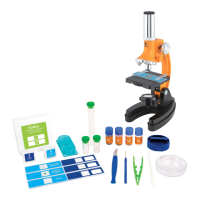
Your microscope kit comes supplied with
sea salt (N, Fig. 1), brine shrimp eggs (O,
Fig. 1) and a shrimp hatchery (P, Fig. 1).
The brine shrimp eggs included with this
set are dried and will remain alive for up to
ve years if stored in a cool, dry place.
Perform the following procedure to hatch
the brine shrimp eggs:
1. To hatch the eggs, rst prepare a brine
solution. Pour the entire contents of the
vial containing the sea salt (N, Fig. 1) into
a quart (946 cc) of water. Add the brine
shrimp eggs into the solution. Allow the
solution to stand at room temperature (70°
- 80°F or 21° - 26°C) for 24 to 48 hours
and the eggs will hatch into nauplius lar-
vae (this is the rst stage of development
after leaving the eggs).
2. Place some of the larvae into one of the
compartments of the shrimp hatchery (P,
Fig. 1).
3. Place some fresh brine solution in an-
other compartment. Add a small amount
of yeast to this new solution. Then, us-
ing an eyedropper, transfer some of the
larvae into this compartment as well.
The yeast will serve as food and produce
oxygen for the larvae as they develop into
maturity. Without food and oxygen, the
shrimp cannot develop and will die.
Mature brine shrimp are known as Artemia
Salina.
4. Observe the life cycle of the shrimp as
they grow: the dried eggs, the hatching
eggs, the developing larvae, and nally,
the mature shrimp.
5. The mature shrimp may be fed to sh in
an aquarium if you so wish. However, rst
remove the shrimp from the brine solu-
tion and place them into fresh water. An
increase in salt may harm the sh in the
aquarium.
Make Your Own Slides
It’s so easy to make slides that the vari-
ety of slides you can create will be limited
only by your own imagination.
NOTE: Use the color lter
especially when looking at
clear or dim specimens.
Need Help? Toll Free 866-252-3811




 To Next Page