EasyManua.ls Logo

BRUEL & KJAER 1022 - Calibration Procedure; Using Output Terminals

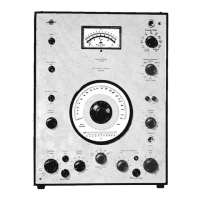
BRUEL & KJAER 1022
60 pages
Print Icon
To Next Page IconTo Next Page
To Previous Page IconTo Previous Page
Loading...
A.
Calibration.
1.
Snap
the
toggle
switch
marked
POvVER
to "
on"
and
allow
two
minutes
warm
up.
2.
MODULATION
FREQUENCY
and
COMPHESSOR
SPEED
to
their
"off"
position.
3.
Turn
main
scale
pointer
until
it
is
on
the
frequency
of
the
line
voltage
(e.g.
50
or
60
c/s),
checking
that
the
frequency
incremental
scale
is
on
zero.
If
not,
set
by
FREQUENCY
INCREMENT
knob
to
this
point.
4.
Set
suitable
deflection
on
the
:n1:eter
by
tuning
the
knob
marked
OUTPUT
LEVEL
to
higher
than
center
scale
reading.
5.
Press
POWEH
FHEQUENCY
BEAT
butlon
and
hold
to
"in"
po
,
sition
and
at
the
same
time
rotate
FHEQUENCY
SCALE
ADJUSTMENT
FINE
slowly,
until
a
large
fluctuation
registers
,
slows
up,
and
practically
ceases
on
the
meter
dial.
If
the
scale
is
widely
out
of
tune,
two
points
may
be
found
where
this
occurs,
only
one
of
which
is
correct
and
therefore
a
check
as
outlined
in
the
following
paragraph
should
be
carried
out,
firstly
releasing
the
POWEH
FREQUENCY
BEAT
button.
6.
Turn
the
main
scale
pointer
to
twice
the
mains
frequency
(100
or
120
c/s)
and
if
improperly
tuned
the
me:er
needle
will
drop
to
zero
indica
-
tion.
Then
FHEQUENCY
SCALE
ADJUSTMENT
FINE
must
be
re-aligned,
but
however,
if
the
other
zero
point
cannot
be
found
and
is
outside
the
range
of
the
FINE
control,
align
the
variable
capacitor
marked
COARSE
with
a
screwdriver
to
give
a
suitable
selling,
which
should
occur
al
some
point
between
4
and
6
on
FREQUENCY
SCALE
ADJUST-
MENT
FINE.
8.
Operation
Us
,
ing
the
Output
Terminals
Mark<'d
LOAD.
Apply
the
following
proceclure:
-
1.
Set-up
and
calibrate
the
oscillator
as
described
in
A.
2.
Place
the
MATCHING
IMPEDANCE
switch
in
a
suitable
position
for
the
application.
N.B.
Full
deflection
of
the
instrument
meter
corresponds
to
the
voltage
indicated
by
the
switch
position.
3.
Connect
the
load
to
the
output
terminals
marked
LOAD.
N.B.
Hight
terminal
is
grounded.
4.
Turn
the
pointer
on
the
main
frequency
dial
to
the
desired
frequency,
finely
adjusting
the
Frequency
Increment
if
necessary.
(For
automatic
frequency
sweep,
see
under
E).
5.
Select
a
suitable
output
voltage
hy
turning
the
knob
marked
OUTPUT
LEVEL.
14: