EasyManua.ls Logo

BRUEL & KJAER 1623 - Using the Tracking Frequency Multiplier; Using the Special Noise Filter

BRUEL & KJAER 1623
36 pages
Print Icon
To Next Page IconTo Next Page
To Previous Page IconTo Previous Page
Loading...
4.6.
USING
THE
TRACKING
FREQUENCY
MULTIPLIER
Once
the
1
623
has accepted a
tuning
signal (indicated by an
illuminated
Track
window
and a stable
frequency
display)
the
filter
can be
tuned
to
any
harmonic
or
subharmonic
of
this
frequency
within
the
range
99/1
to
1/99
and
within
the
frequency
range
2Hz
to
20kHz.
The desired
ratio
is set on
the
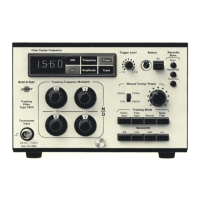
TRACKING FREQUENCY MULTIPLIER
Numerator
and
Denominator
knobs.
For
example,
if
a
photoelectric
or
magnetic
pickup is used
to
provide
a
tuning
signal
from
the
blades
of
a
five-bladed
fan,
the
filter
is
tuned
to
the
fundamental
rotation
frequency
by
setting
the
TRACKING FREQUENCY MULTIPLIER
to
1/5.
If
it
is
further
required
to
exam-
ine
the
5th
harmonic
of
the
fundamental
rotation
frequency
one
should
set
the
tracking
frequency
ratio
to
5/5
rather
than
1/1
because
any
slight
unevenness
in
the
angular
spacing
of
the
blades
will
be averaged
out
. This is
due
to
the
tuning
circuitry
in
the
1623
only
seeing one
of
the
five pulses
from
the
pickup
per
revolution.
It
should
be noted
that
the
frequency
range
2Hz
to
20kHz
applies
to
the
filter
tuned
fre-
quency.
It
is,
to
a
certain
extent,
possible to
tune
the
filter
from
signals
which
have
fre-
quencies
outside
these
limits
if
the tracking
frequency
multiplier
is used
to
bring
the
tuned
frequency
inside
the
limits
and
assuming
a
well
defined
waveform
of
high
level.
4.7.
USING
THE
SPECIAL
NOISE
FILTER
The
right
hand
pushbutton
of
the
TRACKING
MODE
pushbuttons
marked
Noise
Filter
couples a
low
pass
filter
into
the
tuning
signal
input
which
can
be used
where
it
is
su-
spected
that
high
frequency
ripple
may
be
disturbing
a
low
frequency
tuning
signal.
The
rejection
characteristic
of
the
noise
filter
is
shown
in Fig
.4.
7.
0
10
20
40
50
60
20 30 40 50
~
~
\
\
\
100
200 300 500
\
(
~
I
1000 2000
Frequency Hz
~'--..
""'
3000
770311
Fig. 4.
7.
Frequency
response
of
the
special
low-pass
noise
filter
in
1623
In
normal
circumstances
with
the
Noise
Filter
pushbutton
in,
the
noise
filter
automati-
cally
becomes
inoperative
when
the
tuning
signal
frequency
exceeds approx.
200Hz
and
couples
in
again
when
the
tuning
signal
frequency
falls
below
approx.
200Hz.
23

Related product manuals