EasyManua.ls Logo

BRUEL & KJAER 1623 - Tuning from the Filtered Output Signal

BRUEL & KJAER 1623
36 pages
Print Icon
To Next Page IconTo Next Page
To Previous Page IconTo Previous Page
Loading...
0,25
0,5
c
] 2,5
~
u
~
5
~
~
10
a:
c.
Q)
~
25
~
30
g
....1
50
100
250
500
100~
50
.........
N
~I"
I . I . I
""
ote
: a
1d
for
denommator settmgs D < 1 0
25G
"
for
D > 10,
multiply
Time
by
-RJ
10
~
I I 110
---5~~
~
and
multiply
Sweep Rate
by
0
-u;
I~
"~
-
~
~
2,5
-
~
~
-z.,
~~-1
-~~----~
- _
_'~e
••
"
~
--
--+-,~"
0,5
!
........_
~%
li. 1
0"<"-?
""'
Max. sweep rate
with
2306
I
":
~
'""
0,25
I
O"t-?
I
~~
G
"~
I
I
~
0,1
""'
I~
~
I
I
0,05
I I
I'...
2
5
10
20 50
100 200
500
1
000
2000
4000
Frequency (Hz)
760863
/ 1
Fig. 4.
B.
Chart
for
determining
the
recommended
maximum
fre-
quency
sweep
rate
and
the
recommended
minimum
fre-
quency
sweep
time
for
a
filtered
signal
amplitude
inaccu-
racy
<
-1
dB
(additional
to
specified
filter
gain
accuracy).
The
example
shows
a
10Hz
to
50
Hz
sweep
with
the
12%
bandwidth
filter
requiring
a
sweep
time
of
5 s - 1 s = 4 s.
With
a
logarithmic
sweep
the
sweep
rate
(determined
by
the
lowest
frequency,
10Hz)
will
be 5
decades/min.
The
sweep
rate
could
be
progressively
increased
with
increa-
sing
frequency
to
25
decades/min.
at
50
Hz
4.9.
TUNING
THE
1623
FROM
THE FILTERED OUTPUT
SIGNAL
In
certain
circumstances,
for
example
where
an
external
tuning
signal
is
not
available
and
where
the
filter
input
signal
is
unsuitable,
the
filter
can
be
tuned
from
the
filtered
output
signal.
This
only
applies to
tuning
within
one
of
the
decades
2Hz
to
20Hz,
20Hz
to
200Hz,
200Hz
to
2kHz,
and
2kHz
to
20kHz,
and
assumes
that
a
well
defined
fre-
quency
component
can be located.
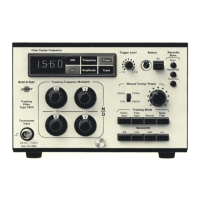
A BNC T
connector
is used
at
the
FILTER OUTPUT socket
with
one
leg
feeding
the
mea-
suring
instrument
used and
the
other
leg connected via a BNC-BNC cable
to
the
TA-
CHOMETER INPUT socket.
To
obtain
a
stable
tuning
frequency
it
will
often
be
necessary
to
average
over several pe-
riods
of
the
tuning
signal.
This
is achieved by setting
the
TRACKING FREQUENCY
MULTI-
PLIER knobs to,
for
example,
04/04.
A
suitable
tuning
signal
must
be located in
the
filter
output
signal
by
searching
with
the
MANUAL
TUNING/PRESET
knob
and
the
trigger
level
must
be
adjusted
to a
suitable
le-
vel.
Setting
up
the
filter
in
this
way
will
often
take
some
time
and
patience
but
the
task
can be
simplified
by
monitoring
the
tuning
signal
with
an
oscilloscope
(via a BNC 'T'
con-
nector
at
the
Tachometer
Input). The
miniature
battery
operated
Oscilloscope Type
4
714
is
convenient
for
this
purpose.
Setting-up
is
more
critical
with
narrow
bandwidths,
therefore
select
the
23%
bandwidth
filter
when
possible.
25

Related product manuals