EasyManua.ls Logo

BRUEL & KJAER 1623 - 1 Introduction and Specifications (Product Data)

BRUEL & KJAER 1623
36 pages
Print Icon
To Next Page IconTo Next Page
To Previous Page IconTo Previous Page
Loading...
FEATURES:
Battery
operated
Frequency range 2
Hz
to
20kHz
Three selectable
filter
bandwidths
6%, 1 2%,
23%
(1
/3
Octave)
Tunable
from
practically
any
periodic
signal
Manual
tuning
facility
Filter
frequency/tuning
signal
frequency
ratio
adjustable
between
99/1
and
1/99
Synchronization
signals
for
level
and
X-Y recorders
Wide
dynamic
range,
>60
dB,
with
crest
factor
capability
4
Large
digital
display
of
filter
centre
frequency
Low-pass
noise
filter
for
tuning
signal
USES:
Synchronous
vibration
analysis
of
rotating
machinery
Harmonic
analysis
of
vibration
and
electroacoustic
signals
Filtering
of
response
signals
in
vibration
testing
set-ups
Harmonic
distortion
measurements
on
gramophone
pick-ups
19-300
type 1
623
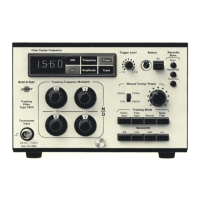
Tracking Filter
Filter Center Frequency
Trigger
level
Betterv
- -
~
- -
~------~
------
Recorder
Sync.
~
11',:,//
~
L
___
- -
---------
On
Tracking
Filter
Type
1623
Introduction
The
fully
portable,
battery
oper-
ated, Tracking
Filter Type 1
623
is a
narrow
bandwidth
filter
whose
cen-
tre
frequency
automatically
locks
onto
and
follows
the
fundamental
frequency,
or a
harmonic,
of
a peri-
odic
tuning
signal
originating
from,
for
example, a
tachometer
or
vibra-
tion
transducer
. Its
small
size and
built-in
battery
power
supply make
it
ideal
for
field
operation
with
the
general purpose
Vibration
Meter
Type
2511.
When
combined
with
a sound lev-
el
meter,
vibration
meter,
or mea-
suring
amplifier,
sound,
vibration,
and
other
signals
which
can be con-
verted to
electrical
waveforms,
can
be
analyzed
as
a
function
of
a vari-
able
frequency
reference signal.
As
a typical example, can be quoted
the
synchronous
vibration
analysis
of
an
engine
being
run
up in speed;
the
vibration
level measured can be
plotted as a
function
of engine
speed, and
the
development
of re-
r Menual Tuning/ Preaet '
e
2
00
Hz
20kH
z
2H
z
200H
z
,----
Tracking
Mode
~
Tachm. Filter Nol18
Input Input Manual Filter
sonances excited by
the
fundamen-
tal rotation
frequency
and its var-
ious
harmonics
can
then
be
stud-
ied.
Filters
Both
the
tuning
signal frequency
and
the
filter
frequency
ranges
cover
2Hz
to
20kHz
in one range
with
automatic
tuning.
Three con-
stant
percentage
bandwidth
filters
are provided
with
"white
noise"
bandwidths
of
6%, 1 2% and
23%
(
1/3
Octave)
of
the
tuned fre-
quency.
Constant
percentage band-
width
filters
give a
constant
resolu-
tion
on a
logarithmic
frequency
scale and are
therefore
able to give
a
relatively
quick
analysis over a
wide
frequency
range.
The
filter,
which
has a dynamic
range
of
about
70
dB, consists of a
digitally
tuned
pair
of two-pole
But-
terworth
filters
that
give good selec-
tivity
with
an
attenuation
of
1 2
dB/octave.
Characteristic curves
for
the
filters
are
shown
in Fig .1.

Related product manuals