EasyManua.ls Logo

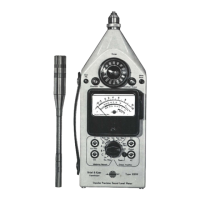
BRUEL & KJAER 2206 - Calibration; General; Calibration with Microphone Type 4148; Sound Measurements

BRUEL & KJAER 2206
24 pages
Print Icon
To Next Page IconTo Next Page
To Previous Page IconTo Previous Page
Loading...
3.4.
CALIBRATION
3.4.1.
General
The
meter
and
microphone
are
calibrated
together
before
they
leave
the
factory
to
give
correct
readings. The
calibration
is
stable
with
time
but
can
change
due
to
the
effects
of
impact
or
adverse
conditions
.
Frequent
calibration
should
not
be necessary.
Certain
meas-
urement
codes
of
practice,
however,
specify
how
often
equipment
should
be
calibrated.
The
2206
may
be calibrated by
placing
over
the
microphone
an
acoustical
source
which
produces
a steady,
known
sound
pressure
level.
Either
the
Sound
Level
Calibrator
Type
4230
or
Pistonphone
Type
4220
is
recom-
mended.
The
4230
generates
94
dB
0,25
dB)
at
a
frequency
of
1000Hz
while
the
4220
generates
124
dB
0,2
dB)
at
a
frequency
of
250Hz.
Detailed
descriptions
of
these
calibrators
are
to
be
found
in
their
respective
Instruction
Manuals
.
3.4.2.
Calibration
with
Microphone
Type
4148
The
calibration
procedure
when
the
2206
is used
with
the
microphone
with
which
it
is
normally
supplied
(Type 41
48)
is as
follows
:
1.
Attach
the
microphone,
extension
rods
or
cables and
adaptors
by
screwing
them
to-
gether
finger
tight.
(See
section
3.3.).
These
must
be
included
in
the
calibration
as
they
all
affect
the
sensitivity.
2.
Turn
the
POWER SWITCH to
"Batt."
and
check
the
battery
voltage:
Then
set
the
switch
to
"Fast"
and
the
WEIGHTING NETWORK SELECTOR
to
either
"C"
or
"Lin."
.
3 .
Set
the
RANGE SWITCH
to
either
"90"dB
if
the
Sound
Level
Calibrator
Type
4230
is
being
used or
"120"dB
if
the
Pistonphone
Type
4220
is being used.
Allow
about
25
seconds
for
the
circuits
to
charge
up.
4.
Fit
the
half
inch
adaptor
onto
the
acoustic
calibrator
then
place
the
calibrator
snugly
over
the
microphone
.
Switch
on
the
calibrator
and
hold
it
steady
on
the
micro-
phone
.
5.
Adjust
if
necessary
the
screw
of
the
SENSITIVITY
ADJUSTMENT
with
a
small
screw-
driver
to
give a
meter
reading
of
either
"+
3,8"
(equivalent
to
93,8
dB)
for
the
4230
or
to
give a reading
of
the
value
on
the
calibration
chart
(corrected
if
necessary
for
barometric
pressure)
for
the
4220.
(See also
the
relevant
Calibrator
Instruction
Man
-
ual).
3.5.
SOUND
MEASUREMENTS
3.5.1.
General
8
The
accompanying
booklet
entitled
Measuring
Sound
should
be read
through
before
pro-
ceeding
with
measurements
as
it
contains
much
useful
general
information
on
the
sub-
ject.
One
or
two
points
should
perhaps
be
emphasized.
Ensure
that
the
microphone
has
the
required
dynamic
range,
frequency
range
and
directional
characteristics.
Always
use
a
windshield
for
outdoor
measurements
and
in
a
dusty
environment.
Various
nose cones are available
for
reducing
wind
noise as
well
as
dehumidifiers.
En- ·

Related product manuals