5.
OPERATIONAL CHARACTERISTICS
AND
ACCURACY
5.1. DIRECTIONAL CHARACTERISTICS
Ideally a sound level meter should
have
the
same
sensitivity
for
sound
coming
from
all directions.
Unfortunately
this cannot
be
achieved in
practice except in the
case
of
relatively low frequencies
because
of
inter-
ference
from
the body
of
the instrument
or
from
the microphone itself.
For higher frequencies, when the dimensions
of
the sound level meter
are
comparable
to
the wavelength
of
the sound, the sound field around the
instrument
will
be
disturbed
and
the pressure on the microphone diaphragm
will
depend on the direction
from
which the sound
is
coming.
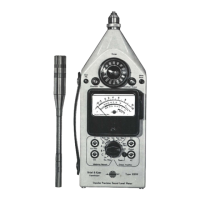
· Tests were made on the 2209 in
an
anechoic chamber
(without
the
operator present
unless otherwise stated). In all
cases
readings were taken
with
the meter held in
two
positions -
with
the meter horizontal,
front
panel upwards
and
with
the meter horizontal,
front
panel sideways.
.,
-1
MeasurinoClbiect:
---
Br
uel & Kj
..
r
I
DDDDO
OOOODDOOOOOOODOOOOOOOOD
OO
OOOOODOOOO
Si;ft.:
Door.
P-
: Z....Lo.ol:
10
2209 +
UA
0196 + 4145 + UA 0055
Free-
fi
eld
Response
fo
r 0" i
nc
idence
SdB
100
Hz
Wrto~ng
s,-1
:
10KHz 20
.
_,_
.
;f&•l
(.
~
Fig.5.1. Typical free-field response
for
00
incidence
with
Gooseneck
and
One Inch Microphone
fitted
with
Random Incidence Corrector
49


 To Next Page
 Loading...