EasyManua.ls Logo

BRUEL & KJAER 2209 - Introduction; Sound Level Meters

BRUEL & KJAER 2209
119 pages
Print Icon
To Next Page IconTo Next Page
To Previous Page IconTo Previous Page
Loading...
1.
INTRODUCTION
1.1. SOUND LEVEL METERS
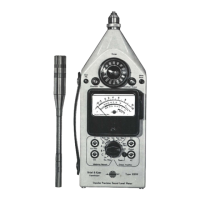
Sound
Level Meters are
required
to
measure noise
of
different
levels,
spectra,
and
waveforms
under
widely varying
conditions
of
sound
source
distribution
and
reflections
at
the
boundaries
of
the
sound
field. Usually
the
purpose
of
these
measurements,
whether
they
are
estimating hearing
damage
risk,
annoyance,
acoustical insulation efficiency,
acceptability
of
manu-
factured
products
or
any
other
factor,
is
to
collect
data
which will improve
the
understanding
of
a
problem
and
thereby
help in solving it.
Obviously, an
instrument
giving readings
which
can
be
related
to
subjective impressions
of
loudness
would
be desirable.
Attempts
have
been
made
in
the
past
to
design such an
instrument,
but
the
difficulties involved
in simulating
the
human
hearing system
cannot
yet
be
overcome.
The
Inter-
national Electrotechnical
Commission
(I
EC), has decided
that
the
most
practical solution
is
to
standardize
an
apparatus
by
which
sound
pressure
can be measured
under
closely
defined
conditions,
so
that
the
results
ob-
tained
by
different
users
may
be
compared.
Two
I
EC
publications
,
l:lave
been issued
to
specify
the
desirable character-
istics
of
sound measuring
instruments.
Publication
123
presents
require-
ments
for
a
Sound
Level Meter,
and
these
requirements
were
made
more
stringent
in
Publication
179
for
Precision
Sound
Level Meters.
The
Brliel &
Kjc;er
Type
2209
is
designed
to
the
specifications
of
IEC Publication
179.
It
is
appropriate
to
mention
some
of
the
main
requirements
of
the
IEC
Standard:
The
Precision
Sound
Level Meter
must
measure
the
free-field
sound
pressure level
with
an
accuracy
of
± 1 dB
under
specified reference
conditions
simulating normal use.
The
microphone
must
have directional sensitivity
within
certain limits
which
are specified.
The
indicating
instrument
must
be
of
the
square-
law
type,
and
calibration
of
the
meter
scale
and
the
error
associated
with
a range
shift
must
be
within
specified tolerances.
5

Table of Contents

Related product manuals