A meter-dynamic characteristic referred
to
as Fast must be provided.
This
must
produce
a
meter
response
to
a signal
of
200
milliseconds
duration
which indicates
within
~
~
dB
of
the
indication
for
a
steady
signal
of
the
same
frequency
and
amplitude.
Damping
is
specified
by
the
requirement
that
overswing
of
the
steady level
produced
by
a
suddenly applied signal
must
be
within
the
limits!
6:
~
dB.
An alternative
dynamic
characteristic referred
to
as
Slow
is
an
optional
feature. With
this
response,
the
meter
indication
produced
by
a
500
milliseconds
duration
signal
must
fall
between
=~
dB
from
the
meter deflection
produced
by
a
steady
signal
of
the
same
frequency
and
amplitude. Overswing
due
to
sudden
application
of
a
steady
signal
must be within
!
6:~
dB
of
the
final steady indication,
and
this
indica-
tion
should
not
differ
from
the
level indicated
with
Fast characteristic
by
more
than
0.1 dB.
Frequency
ranges in which these
two
dynamic
characteristics
must
be
met
are specified. Specifications are also laid
down
for
the
maximum
permissible sensitivity
to
external influences:
the
influence
of
the
sound
field
on
the
meter
in
the
absence
of
a
microphone
signal, vibrations, magnetic fields,
electrostatic
fields,
temperature,
humidity.
The
recommendation
also lays
down
the
test
procedure
which should be
employed
in
checking
the
compliance of an
instrument
with
these
require-
ments.
It
is
specifically stated
in
the
I EC Publication
that
the
Precision
Sound
Level Meter
is
an
instrument
which
is
designed
to
give an objective measure-
ment
which
approximates
a subjective impression
of
sound
under
certain
conditions. An
instrument,
such as
the
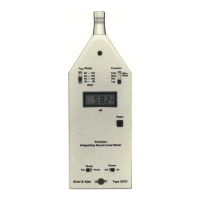
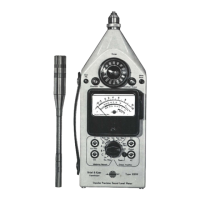
2209,
which fulfils
these
require-
ments can be used for assessment of most
continuous
sounds.
Measurement
of
discontinuous
sounds
or
sound
of
very
short
duration
must be
treated
separately.
1.2. IMPULSE SOUND LEVEL METERS
The
problem
of
how
to
produce a meter reading which reliably approxi-
mates a subjective impression
of
a sound
of
short
duration
(considered as
duration
from
1
to
1000
milliseconds) has been a research
topic
of
consider-
able interest for some years.
The
difficulty lies
in
the
specification
of
a
meter response characteristic which closely
approaches
the
rise
time
of
the
human ear
and
stores, averages, and
"forgets"
the
short
duration
signal
in
a
6


 To Next Page
 Loading...