7.2. TAPE RECORDING OF SOUND
AND
VIBRATION
DATA
The principle applications
of
a tape recorder in the field
of
sound and
vibration measurements are:
a)
Repetition
of
transient signals
for
frequency analysis.
b)
Data collection and storage
for
later analysis.
c)
Frequency transformation.
In
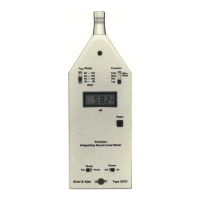
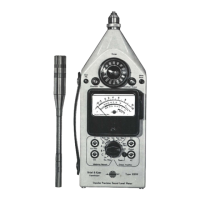
all these applications the 2209 provides a high
quality
input
to
the
recorder and
it
becomes especially valuable
for
field measurements
with
a
battery operated
portable recorder
such
as
the 8 & K
Type
7003
or
7004.
The
AC
OUTPUT socket
of
the Sound Level Meter should
be
connected
to
the high impedance
input
of
the Tape Recorder.
If
a recording level greater
than 0.5
Vis
required,
then
the METER SWITCH must
be
in position
"Batt.
( Rec.)".
In
this
case
the maximum permissible load
is
10
KQ
and
the
output
voltage which would correspond
to
full
scale
meter deflection
is
5 V RMS.
In
this mode the meter indicates
only
the condition
of
the batteries. For
recording
levels
of
the order 0.5 V, recordings may
be
taken
from
the OUT-
PUT AC socket
with
the METER SWITCH in position "Peak
Hold",
"Imp.
Hold",
"Imp.",
"Fast",
or
"Slow".
For recording levels much
less
than 0.5 V external attenuation must
be
introduced between the Sound Level Meter and the Tape Recorder.
7.2.1. Recording and Replaying
(
1)
Using a known Reference Signal calibrate the 2209
as
described in
Chapter 2.
~-----------~
®0.
I I
...___Q-L-1
1..-.1..()-------t~
. 0
2209
~
I
I I
Tape Recorder
I I
L------------J
Ext.
Attenuator
172082
Fig.7.5.
Tape
recording
of
sound level
94


 To Next Page
 Loading...