Chapter 3 – Taking Measurements
Calibration
18
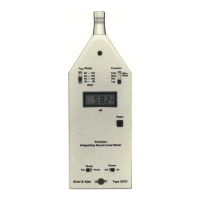
Brüel & KjærIntegrating Sound Level Meter Type 2239 A
User Manual
3.1.3 Free- and Diffuse-Field Measurements
The sound level meter is calibrated in the same way for free-
field measurements (according to IEC) and diffuse-field meas-
urements (according to ANSI). However, the calibration levels
for some calibrators may be different, depending on which
measurements are to be made. See your calibrator’s user man-
ual for details.
Always remove the Random Incidence Corrector DZ 9566 (if
fitted) from the microphone when calibrating or checking the
calibration.
3.1.4 Which Calibrators Can I Use?
The sound level meter can be calibrated using Brüel & Kjær
Sound Level Calibrator Type 4231 or any other certified sound
level meter calibrator that emits a 1 kHz signal at 94 dB.
Each individual calibrator is slightly different. The actual cal-
ibration level is not necessarily equal to the nominal calibra-
tion level. Therefore, it is important to check the level listed
on the chart included with your calibrator and set your sound
level meter accordingly.
3.1.5 Calibrating Type 2239 A
1. Stand away from loud noise sources.
2. If fitted, remove Random Incidence Corrector DZ 9566.
3. Fit the calibrator carefully onto the sound level meter and
rest the assembly on a table or other flat surface as shown
in Fig. 3.1. Ensure that the calibrator fits snugly on the
microphone.
4. Press to switch on the sound level meter.
5. Press to stop the sound level meter from measuring.
bb221911.book Page 18 Tuesday, July 24, 2001 11:23 AM


 To Next Page
 Loading...