Chapter 3 – Taking Measurements
Reading the Parameters
BB 1219 – 11
25
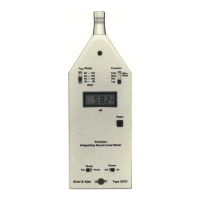
Integrating Sound Level Meter Type 2239 A
User Manual
●
Printed results indicate an overload by showing “Over-
load” on the printout (see section 4.2.2)
● Spreadsheet results have a special overload column in
which overloads are indicated with “
Y”.
3.3 Reading the Parameters
Seven parameters are monitored by the sound level meter.
Two parameters are displayed at a time; one in each of the
bottom two lines of the Measurement Window. To change the
parameters displayed on the screen, press .
The displayed parameters have the following meanings:
L
eq
(L
Im
) Equivalent continuous sound level over the elapsed
measurement time. This is the most useful parame-
ter for giving an impression of the average sound
pressure level. Limits to L
eq
are normally prominent
in sound regulations. Note that when an Impulse
time weighting is used, then this parameter is called
“L
Im
”. Because of the characteristics of the Impulse
time weighting, L
Im
is generally higher than L
eq
for
non-stationary signals.
Fig.3.5 Latched overload
RUN 00:05:41
MaxP 94.7 dB
AF Leq 45.8 dB
30 100
Upper limit of the measurement
range (overload if blinking)
bb221911.book Page 25 Tuesday, July 24, 2001 11:23 AM


 To Next Page
 Loading...