Chapter 3 – Taking Measurements
Measurement Settings
28
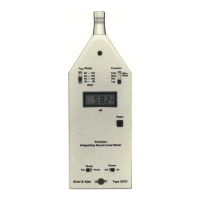
Brüel & KjærIntegrating Sound Level Meter Type 2239 A
User Manual
For a complete listing of the available parameter combinations,
see the section 7.3.
3.4 Measurement Settings
Before you begin measuring, your sound level meter must be
set up correctly. Settings that affect measurements and records
are:
● Measurement Range
● Frequency Weighting
● Time Weighting
● Preset Time
● Date and Time
● Calibration (see section 3.1)
This section explains how to make each of the above settings
(except calibration, which is described in section 3.1) and how
they will affect your measurements.
3.4.1 Setting the Measurement Range
The sound level meter is capable of measuring in any one of
three different ranges:
● 30 to 100 dB
● 50 to 120 dB
● 70 to 140 dB
The range you choose will depend on the environment in
which you are measuring. It is important to select the meas-
urement range so that the instrument is sensitive enough to
measure all relevant sound, but not so sensitive that it over-
loads. Your measurement will not be accurate if an overload
occurs. See section 3.2.3 for more information about over-
loads.
bb221911.book Page 28 Tuesday, July 24, 2001 11:23 AM


 To Next Page
 Loading...