EasyManua.ls Logo

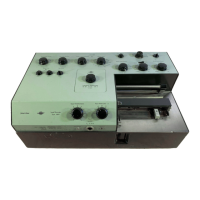
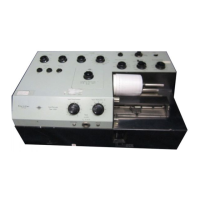
BRUEL & KJAER 2305 - Mechanical System Components

BRUEL & KJAER 2305
130 pages
Print Icon
To Next Page IconTo Next Page
To Previous Page IconTo Previous Page
Loading...
SPEED,
LOWER
LIMITING FREQUENCY
and
POTENTIOMETER
RANGE.
When
the
two
first
knobs
are
combined
so
that
their
settings
correspond
to
points
inside
the
hatched
area
in
Fig
. 2.2
on
page
24,
the
writing
system
will
always
be
in
a
stable
condition,
presuming
that
the
POTENTIOMETER
RANGE
knob
is set
according
to
the
Range
Pot
e
ntiometer
used
.
For
instance
at
"50"
for
a 50 dB
Rang
e
Potentiometer.
Wh
en
settings
are
chosen
outside
the
hatched
area,
the
writing
system
lends
to
overshoot
and
to
be
unstable
.
.
0000000000
0000000000000
00
0000000000000
0000000000
0
W.
S'
IW
.'
Paper
Spied
.100
mm/
••
c.
-_
W.S.·
Writing
Sp.ed
In
mm/.lc.
Fig. 1.5. Curves
showing
the
influence
of
the
writing speed
upon
the
recording
of
an
input
step
voltage
on
100
mm
paper.
Mechanical System.
The
Level
Recorder
Type
2305 is
designed
to
fulfil
a
number
of
operational
requirements
in
combination
with
other
Briiel & Kjrer
instruments
and
yet
at
the
same
time
be
remotely
controlled
.
To
carry
this
out,
various
mechanica
'l
gears,
clutches
and
electromechanical
switches
are
necessary
,
Principle.
In
Fig. 1.6
the
mechanical
drive
system
is
illustrated,
and
with
the
aid
of
this
figure
the
working
principle
will
be
explained.
The
motive
power
is
supplied
from
the
self-starting
synchronous
motor
via
a
worm
drive
to
the
electromagnetic
clutch
.
From
the
clutch
the
power
is
transferred
to a
gear-box
via
the
two
nylon
gear
wheels 1
and
2.
The
gear-
box (described below)
has
two
output
shafts,
Drive
Shaft
1
and
Drive
Shaft
II,
the
speeds
of
which
can
be
chosen
by
the
PAPER
SPEED
and
DRIVE
SHAFT
SPEED
knobs
respectively
.
Drive
Shaft
1.
This
has
a fixed
gear
wheel
3
which
among
others
drives the
reduction
gear
sets
4, 5
and
6,
7.
The
set
6, 7 is
free-running
on
the
Drive
11

Related product manuals