10-110
mV
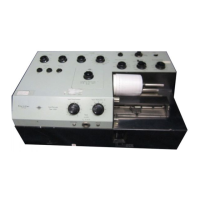
Potentiometer.
When
selling
POTENTIOMETER
RANGE
on
"16"
Fig
. 2.2
can
also
he
used,
but
in
this
instance
the
WRITING
SPEED
should
be
chosen
two
or
more
steps
lower
than
that
given
for
the
limit
of
stability
at
the
particular
LOWER
LIMITING
FREQUENCY settings.
If
the
highest
Writing
Speed
in
Fig. 2.2
has
to
be
utilized
and
the
stylus
deflection
is
in
the
lower
half
of
the
scale
the
POTENTIOMETER
RANGE
has
to
be
set
to
a
value
higher
than
"16"
to
obtain
stable
opera-
tion.
For
a
stylus
deflection
in
the
upper
half
the
POTENTIOMETER
RANGE
setting
need
not
be
higher
than
"16".
It
may
in
this
case
even
be
set
to a
lower
value,
ensuring
a
higher
resolving
power.
The
last
position
of
the
knob
POTENTIOMETER
RANGE is
marked
"Stand
by".
When
this
position
is
used
,
the
input
10
the
output
amplifier
is
grounded
and
the
writing
system
will
not
respond
to
input
signals.
RECTIFIER
RESPONSE
switch
enahles
the
arithmetical
"Average", the
true
"RMS"
and
the
"Peak"
(half
peak-to-peak)
level
of
an
AC
signal
to
be
recorded.
The
last
position
of
the
switch
marked
"DC"
is
used
when
direct
recordings
of
DC
voltages
have
to
be
carried
out.
NOTE:
When
in
position
"DC"
the
LOWER
LIMITING FHEQUENCY
should
always
be
kept
below
"200".
LOWER
LIMITING
FREQUENCY
rotary
switch
allows
the
averaging
time in
the
rectifier
and
the
negative
feedback
of
the
input
amplifier
to
be
changed
according
to
the
frequencies
under
measurement.
To
ensure
stable
function
of
the
Recorder
and
to
avoid
overshoot
of
the
writing
system,
the
positions
of
LOWER
LIMITING
FREQUENCY
and
WHITING
SPEED
should
be
com-
bined
so
that
they
correspond
to
the
hatched
area
in
Fig. 2.2.
The
prescribed
combinations
in
the
figure
are
valid
for
POTENTIOMETEH
RANGE
when
set
according
to
the
Range
Potentiometer
employed
(see
under
item
"Potentio·
meter
Hange"
above).
Example:
WRITING SPEED "500" mm/sec.
and
LOWER LIMITING FREQUENCY "50"
Hz
(cis)
will
just give stable operation
and
negligible overshoot,
whereas
"500" mm/sec. and "20"
Hz
(cis)
respectively tends to give overshoot.
WRITING
SPEED
rotary
switch
determines
the
damping
(averaging
time)
of
Ihe
writing
system
and
is
chosen
in
accordance
with
the
type
of
recording
required.
*)
The
large
figure
of
the
WRITING
SPEED
calibration
correspond
to
recording
on
paper
of
50
mm
width,
and
the
small
figures
to
recording
on
*)
The
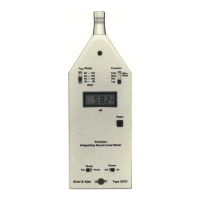
settings of the WRITING SPEED which give the Level Recorder an averaging
time approximately equal to the standardized
meter
characteristics
"Fast"
anel
"Slow"
for sound level meters
are
100
mm/sec.
and
16
mm/sec. respectiYely, when the LOWER
LIMITING FREQUENCY is
kept
at
20
Hz
(cis)
.
28


 To Next Page
 Loading...